Part 1 made the case that access is the amenity residents rely on most, the layer underneath every other amenity, and the one that punishes a community hardest when it fails. Part 2 followed the thread into the management portal, where the complaints residents never put in a survey show up by default: every failed credential, every after-hours lockout, every guest entry that didn't connect.
Reading the signal is the first move. Acting on it is where the return lives.
So this ost closes the loop with the part operators actually care about. Not the theory, and not the diagnosis, but the result. What changes for residents and onsite teams once access control stops being something the team works around, and starts being something they can count on.
We have a clear picture of it, because we asked.
In a recent Gatewise customer survey, 13 of 14 communities reported facing access control challenges before switching. Half of those called the issues significant. The rest called them occasional, the kind of intermittent friction that never quite rises to a capital project but never quite goes away either.
That tracks with the research the series opened on. Grace Hill's 2025 Amenity Paradox report put usage data behind the amenity question, and the KingsleySurveys benchmark underneath it, drawn from more than 7 million residents, found 1 in 4 rate controlled access to their apartment as below average. Unreliable access is not the exception in this industry. It is the starting condition.
When those same communities were asked why they chose Gatewise, three reasons rose to the top: improved security, a better resident experience, and modernizing access control. The pattern is consistent. Operators are not chasing a feature list. They are trying to make a daily source of friction disappear.
Here is what disappeared.
The most visible result is the one that shows up on the onsite team's desk: fewer access complaints.
At LBJ Garden Villas, a garden-style community in Houston that had been working around intermittent access problems, the switch to smartphone-based access cut access-related complaints and smoothed out daily operations. Community Manager Jahaira Gonzales watched each unreliable entry pull the team into troubleshooting; with fewer of those to chase down, the team got that time back for the work that actually improves the community.
Idlewilde Apartments, a garden-style Asset Living community that came in with significant access issues, saw the same thing inside its first six months. Community Manager Malloree Coleman watched the steady stream of access complaints drop after implementation, a change the team registered as a major improvement and, in practical terms, as hours reclaimed that had gone to fixing the same problem twice.
This is the quiet category that Part 1 described: the complaints a community generates only when access is broken. Fix the access, and the category stops producing. That is not a smaller version of the problem. It is the absence of one.
Cutting complaints is the surface result. Underneath it sits a structural one: the work itself gets lighter, and the system stops interrupting it.
Two things drive that. The first is reliability. Cellular-first hardware operates over cellular networks rather than relying on a network connection at each gate or door, so entry remains consistent and the unpredictable failures a community had been planning around simply stop happening. Fewer service disruptions is not a slogan here. It is the difference between a gate that works on a Tuesday night and a one-star review by Wednesday.
The second is onboarding. At LBJ Garden Villas, getting residents into the old system and getting new residents up and running quickly used to be more involved than it should have been, adding steps to an already full day. Now, once a resident is in the system, setting them and any new resident up with working access is simple. Deep PMS integration keeps credentials accurate without the manual workarounds that used to break, so the move-in step that generated friction for years no longer does.
What I love most is how easy it is for residents, and new residents, to get access once they're in our system.
Jahaira Gonzales, Community Manager, LBJ Garden Villas
For the community manager, that is a lighter day. For the regional manager running five to fifteen communities, it is the same lighter day repeated across the portfolio, on a single set of workflows rather than a different login and a different headache at every site.
When the friction leaves, residents notice, even if they never say so in a survey.
Both communities reported resident satisfaction rising after implementation. At LBJ Garden Villas, the change registered as a major improvement overall, with satisfaction climbing as entry became dependable and the everyday experience smoothed out. At Idlewilde, dependable entry plus a genuinely simple experience for residents and staff alike lifted satisfaction across the community.
This is the renewal mechanism Part 1 pointed at. Residents rave about the pool and stay quiet about the gate, right up until the gate fails. A dependable entry experience does not earn a glowing survey comment. It removes the reason a resident would have left a bad one. The communities that win the renewal are not out-amenitizing anyone. They are out-responding to the amenity residents actually use every single day.
The last result is the hardest to measure and the easiest to feel: confidence.
After switching, residents and teams at both communities reported greater confidence in who can access the community, backed by reliable, authorized entry and a clear record of activity. Notice the framing. This is not about fear, and it is not a guarantee. It is the difference between hoping the old system held and knowing, from a real-time log, who entered and when.
That record is also what makes the confidence portable up the org chart. The community manager sees today. The regional manager sees the portfolio. Ownership sees the rollup. The same audit trail that reassures a resident answers the question a regional or an owner was going to ask anyway, before they ask it.
None of these outcomes is a one-time win from a fresh install. They hold because of what sits underneath them.
Reliability independent of the building's internet infrastructure. Multiple access methods so a dead phone or a weak signal never becomes a lockout. PMS integration that keeps the credential lifecycle accurate on its own. Customer success is treated as part of the platform rather than an upsell.
That last one came through unprompted at Idlewilde, where Malloree Coleman named the support as a reason the team trusts the system.
Gatewise brings real simplicity to access control for our residents and our staff, and the support we get from them is excellent.
Malloree Coleman, Community Manager, Idlewilde Apartments
From onboarding through daily operations, the team has real people behind them. In a category where implementation is usually where the friction starts, that is often what turns a good install into a result that lasts.
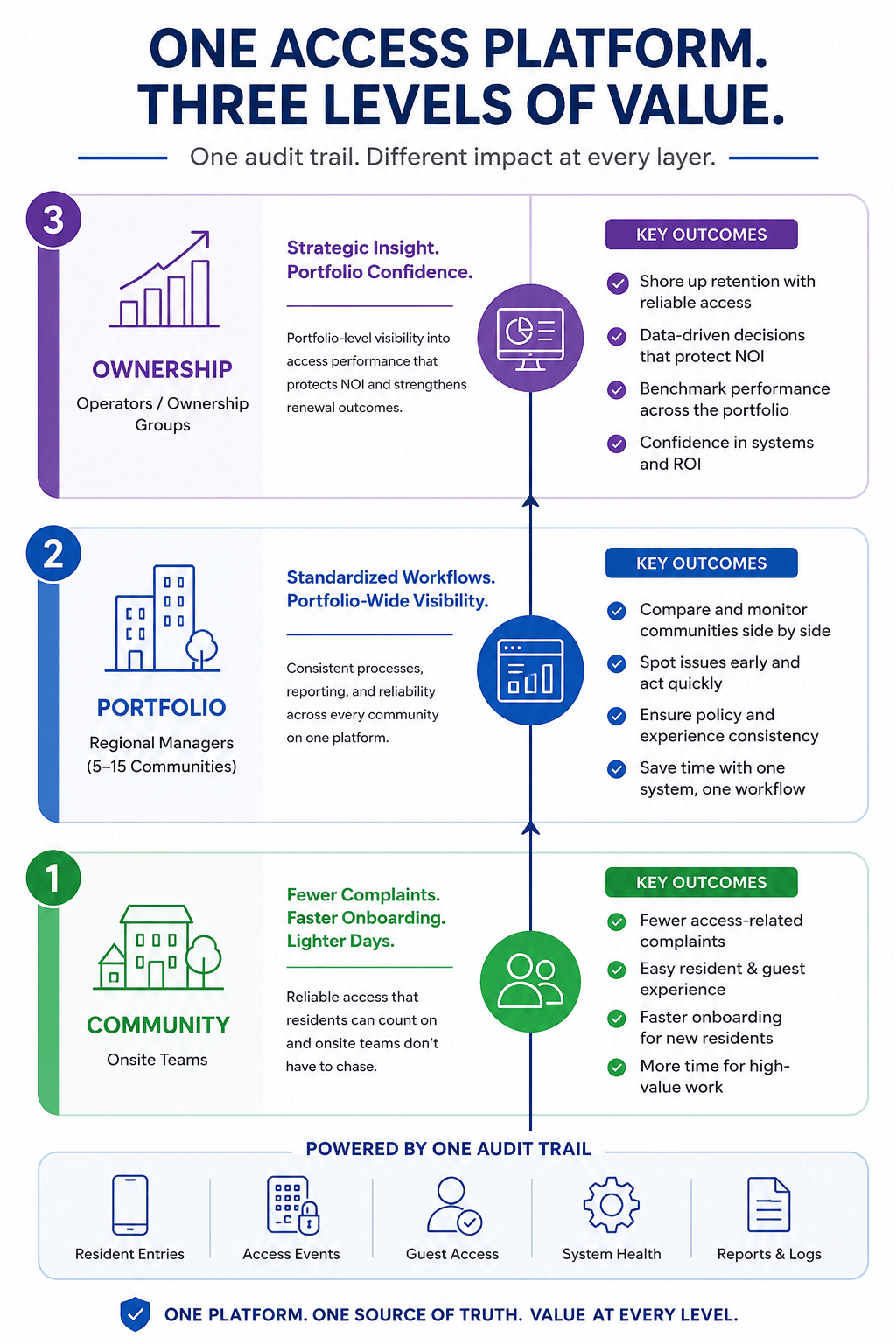
For a community manager, the headline is a lighter day and a shorter complaint queue. For a regional manager, it is that same consistency across every community on one portal, with portfolio-level visibility that does not require a site visit to earn. For an owner or operator, the line runs straight to the number that matters: dependable access protects the resident experience, the resident experience protects retention, and retention is the single largest lever on NOI for most communities.
That is the most NOI-friendly kind of investment, the kind that protects rent rather than chasing it. If you want to put real figures against your own portfolio, the ROI calculator is the place to start.
The amenity series made a single argument. The amenities residents depend on, not the ones they brag about, decide the renewal, and those dependencies show up first in your access logs, not your survey. This is the part operators feel: when you read that signal and act on it, the result is measurable in the only places that count: fewer complaints, lighter operations, fewer disruptions, higher satisfaction, and a community that feels more secure to everyone in it.
Residents remember the amenities that make daily life work. The best ones are invisible. The communities that win are the ones where access just works, every day, without anyone having to think about it.
The amenity series that led here: Part 1, the amenities that matter most and Part 2, what residents won't tell your survey. Or browse more customer success stories.
Gatewise offers a simple and modern gate entry system that provides residents with a mobile app and managers with a cloud-based management portal.