Part 1 made the case that the amenities residents quietly depend on (access, packages, parking) shape renewal far more than the brochure ones do. The corollary lives in the portal.
Grace Hill's 2025 Amenity Paradox report analyzed more than 160,000 resident comments and found a sharp asymmetry. When residents describe what they enjoy about their community, fewer than 20% mention anything about the physical property at all. When asked what could be improved, nearly 80% focus on the physical environment.
Which means residents praise lifestyle and complain about infrastructure. They will rave about the pool and never tell the satisfaction survey that the gate took 90 seconds to open last Tuesday at 11:17 PM. They will tell a friend before they tell the leasing office.
The complaints are real. The data is just somewhere else.
For operators running modern access control technology, that somewhere else has a name: the management portal. Every failed credential, every after-hours unlock, every guest entry that didn't connect, every door held open too long. All of it logged, by default, the moment it happens. Most of it never becomes a ticket. Most of it never appears in the resident's next survey response. But it's all there, and it's the most honest customer feedback an operator has access to.
Here are five signals worth reading, and what to do with each.
The first thing to look for is the resident who's locked out at the community gate or a building entry more than once in a 30-day window. Singular events are noise. The repeat pattern is the signal.
What it usually means: a credential issue.A unit that didn't sync correctly when the move-in was processed. Each individual event is small. The cumulative effect on that one resident is large, and it scales straight into their renewal decision.
What to do: pull the resident's access log inside the portal, identify the failure mode, and fix it before the resident has to call. A PMS-synced credential that activated 12 hours late on move-in day, fixed now, is invisible to the resident. The same credential broken across week one becomes a tour-day complaint nine months later.
Pools, fitness centers, clubhouses, and business centers all earn high satisfaction scores on paper. The portal tells a different story: the gap between attempted and successful entries.
What it usually means: scheduled access that doesn't match how residents actually live. The gym closes at 10 PM but half the building works late shifts. Pool cleaning runs through the morning swim window. The clubhouse door has a credential issue on one specific reader nobody has surfaced. Residents don't write up these frustrations. They just stop trying to use the amenity, then mention it once in their exit interview.
What to do: adjust the schedule in the portal. Extend gym hours into the late shift. Move the vendor window. None of this requires a capital request. All of it shows up in resident experience inside one billing cycle. For mid-rise and high-rise communities especially, where amenity density is part of the rent justification, the portal is the only place this signal lives until renewal time.
Guest access is the most exposed moment in the resident experience. The friend arrived for dinner. The food delivery driver. The Sunday Amazon delivery. Every one of those is a small reliability test, and every one of them generates a portal record.
What it usually means: the gap between guest invitations sent and guest entries completed. A pattern of incomplete entries usually points to a friction point in the invitation flow. The resident isn't sharing the link. The link is expiring too fast. The guest is hitting the wrong gate.
What to do: review the invitation flow with the operations team, and surface clearer resident instructions. Small fix on the operator side. Resident-facing friction drops immediately.
For mid-rise, high-rise, and mixed-use buildings with controlled mailrooms or package rooms, the portal shows entry traffic by hour. Two things to watch.
Heavy traffic at odd hours usually means residents are working around the official delivery window because it's not matching how Amazon, FedEx, and DoorDash actually operate. The fix is policy, not hardware.
Low traffic combined with high package complaints usually means residents are giving up on the package room because something isn't working. A credential failure. A door that's hard to open. A layout that feels insecure after dark. The fix is the room itself.
Either pattern shows up in the portal long before it shows up in the next satisfaction survey. KingsleySurveys benchmark data already flagged that 15%+ of residents say package delivery services are inadequate. The portal is where you find the specific residents and the specific friction point.
The systemic one. Residents who exist in the property management system but not in the access platform, or vice versa. Move-ins that synced late. Move-outs where credentials weren't revoked. Roommate adds that landed in the PMS and never reached access. Vendor accounts that should have expired six months ago and still work.
What it usually means: an integration gap, a manual workaround that didn't get logged, or a permission scope set during onboarding and never revisited. None of these surface in a survey. All of them generate quiet friction, every day, until the day they cause a real problem.
What to do: run a periodic reconciliation between the PMS and the access platform. The Gatewise management portal handles PMS-synced move-ins and move-outs by default, with automated activation and expiration tied to the lease date, role-based permissions, and real-time monitoring across all properties from one dashboard. Operators who run the integration layer correctly close the credential gap before it produces a single complaint.

The thread under all five signals is the same. Residents are giving operators data every single day. Most of it is silent. Almost none of it appears in the next survey cycle. The operators who win the renewal aren't the ones who add another amenity. They're the ones who see the signal first and resolve it before it becomes a review.
That's the operator's edge a smart access control platform creates. Not just credential management, but the resident-experience telemetry that flags friction early. Real-time access logs. Role-based dashboards. PMS-synced move workflows. Granular permissions by user type, time, and location. Every one of those is a complaint that didn't have to happen, which is the most NOI-friendly investment in the stack: the kind that protects rent rather than chasing it.
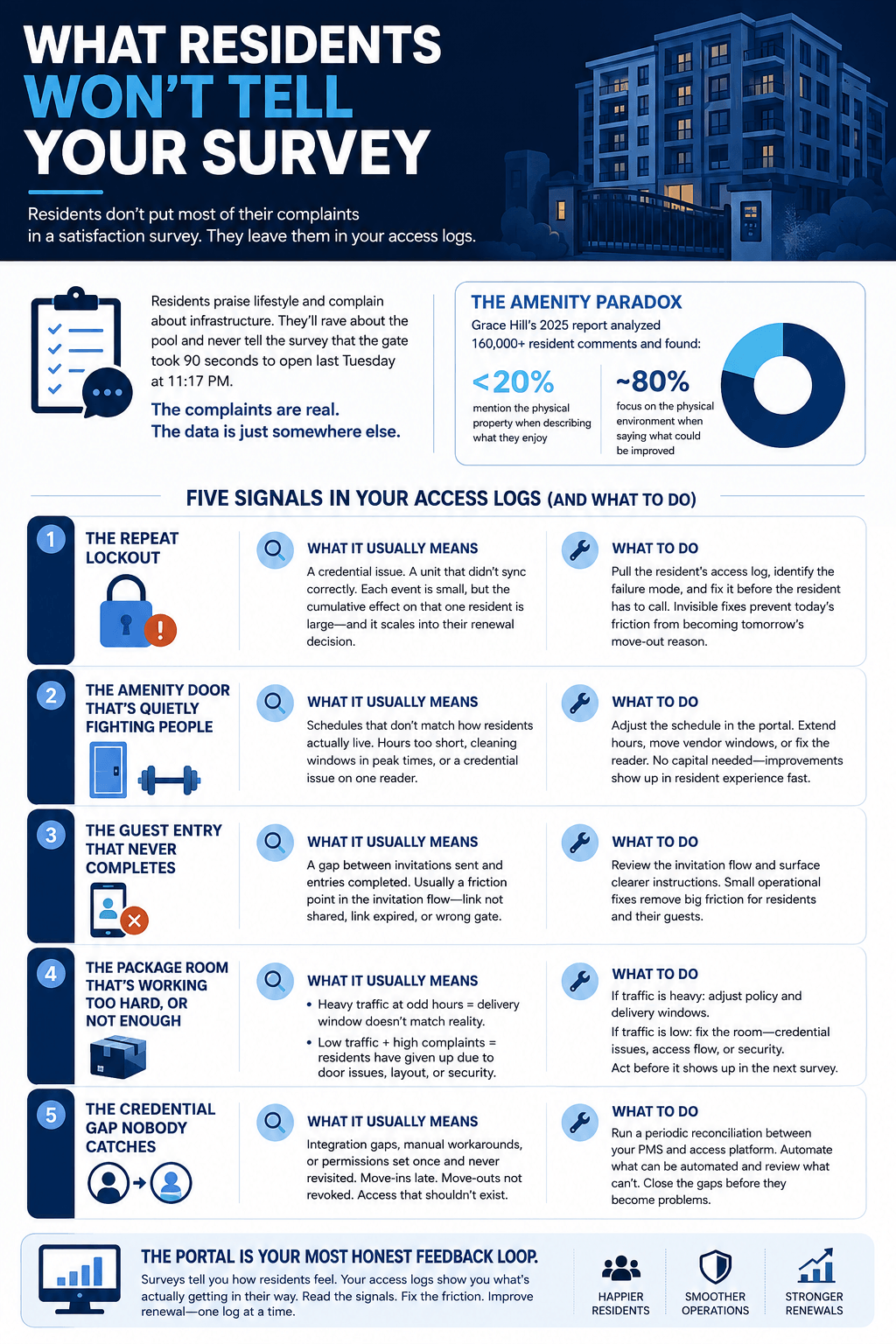
A satisfaction survey tells you how residents feel about the community at one point in the year. The portal tells you what's actually happening to them, every day, in real time. One is the lagging indicator. The other is the leading one.
Part 1 made the case that the amenities residents quietly depend on move retention more than the brochure ones. Part 2 closes the loop: the data that proves which way each resident is leaning, every single day, lives in the system operators are already running.
The communities that read the signal first don't have to outspend on amenities. They just out-respond on the ones residents actually use.
Previous in series: Part 1, on the amenities that actually matter most.
Gatewise offers a simple and modern gate entry system that provides residents with a mobile app and managers with a cloud-based management portal.