Owners and operators have been asking the wrong amenity question for a decade.
The right question isn't "which amenities should we add?" It's "which amenities do residents actually rely on?" Those aren't the same list. And the data on the gap just got published.
Grace Hill's 2025 Amenity Paradox report, built on surveys from 7.3 million residents and prospects, rent and amenity data from 192,400 multifamily properties via HelloData, and more than 500,000 units of access usage data contributed by Gatewise, answered the question more directly than any prior dataset. The amenities residents say they love don't move rent. The amenities residents quietly depend on do.
Which makes the actual amenity hierarchy look nothing like the marketing brochure.
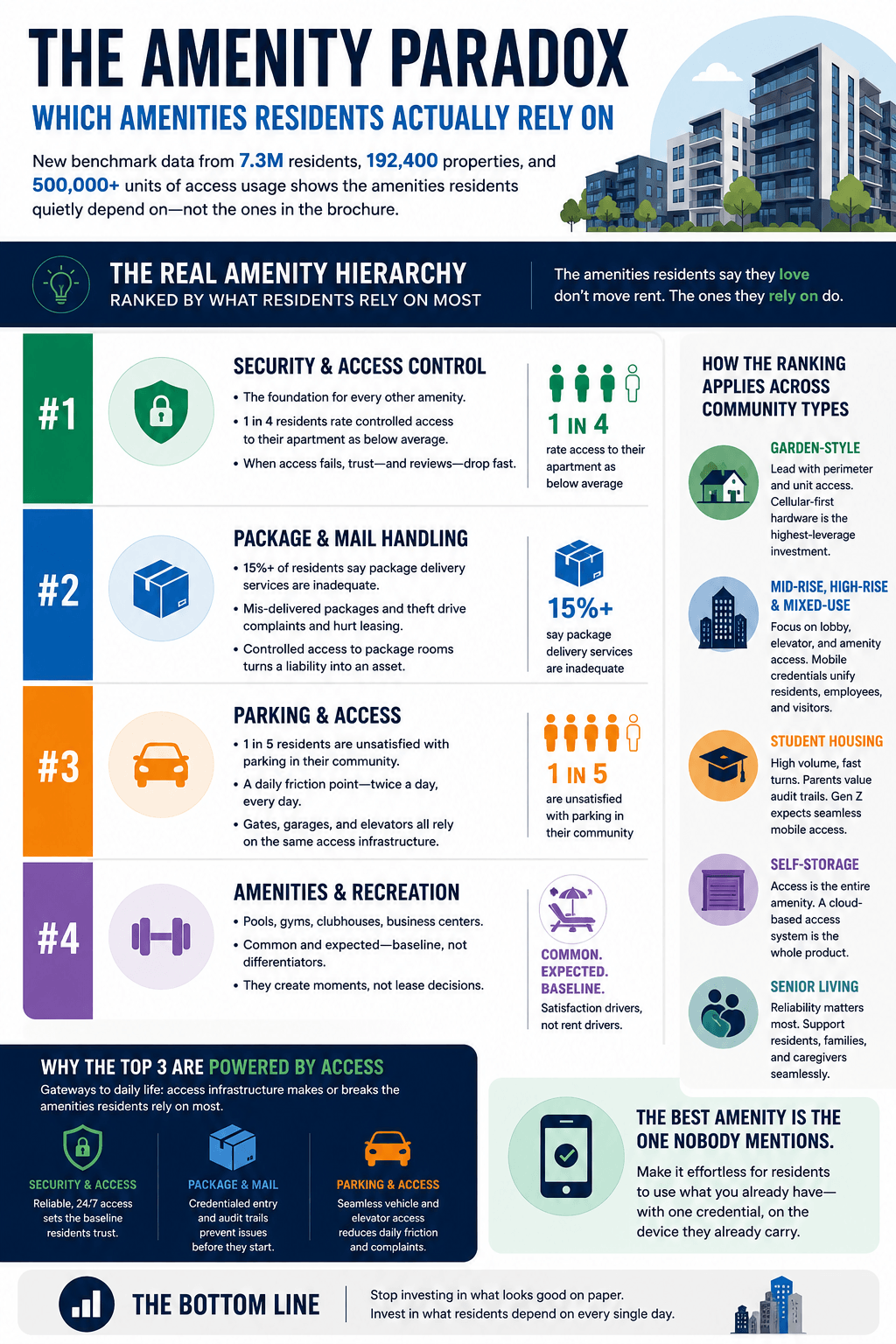
Here's the order, by what residents rely on most.
Access isn't an amenity in the conventional sense. It's the layer between residents and every other amenity, gate, door, and entry point in the community. And it's the most punishing one when it fails.
The benchmark data is unambiguous. KingsleySurveys data from more than 7 million residents shows 1 in 4 rate controlled access to their apartment as below average. Access doesn't move with rent the way the industry assumes. It sets a baseline residents only notice when it's broken.
A keypad that works sometimes is worse than no keypad at all, because residents stop trusting it. A gate that fails on a Tuesday becomes a one-star review by Wednesday. The 24/7 nature of access means there's no time of day when the system gets a break.
The owners who treat access as infrastructure (cellular-first reliability, multi-method credentials, real-time audit trails) get a category of resident complaints that simply doesn't generate.
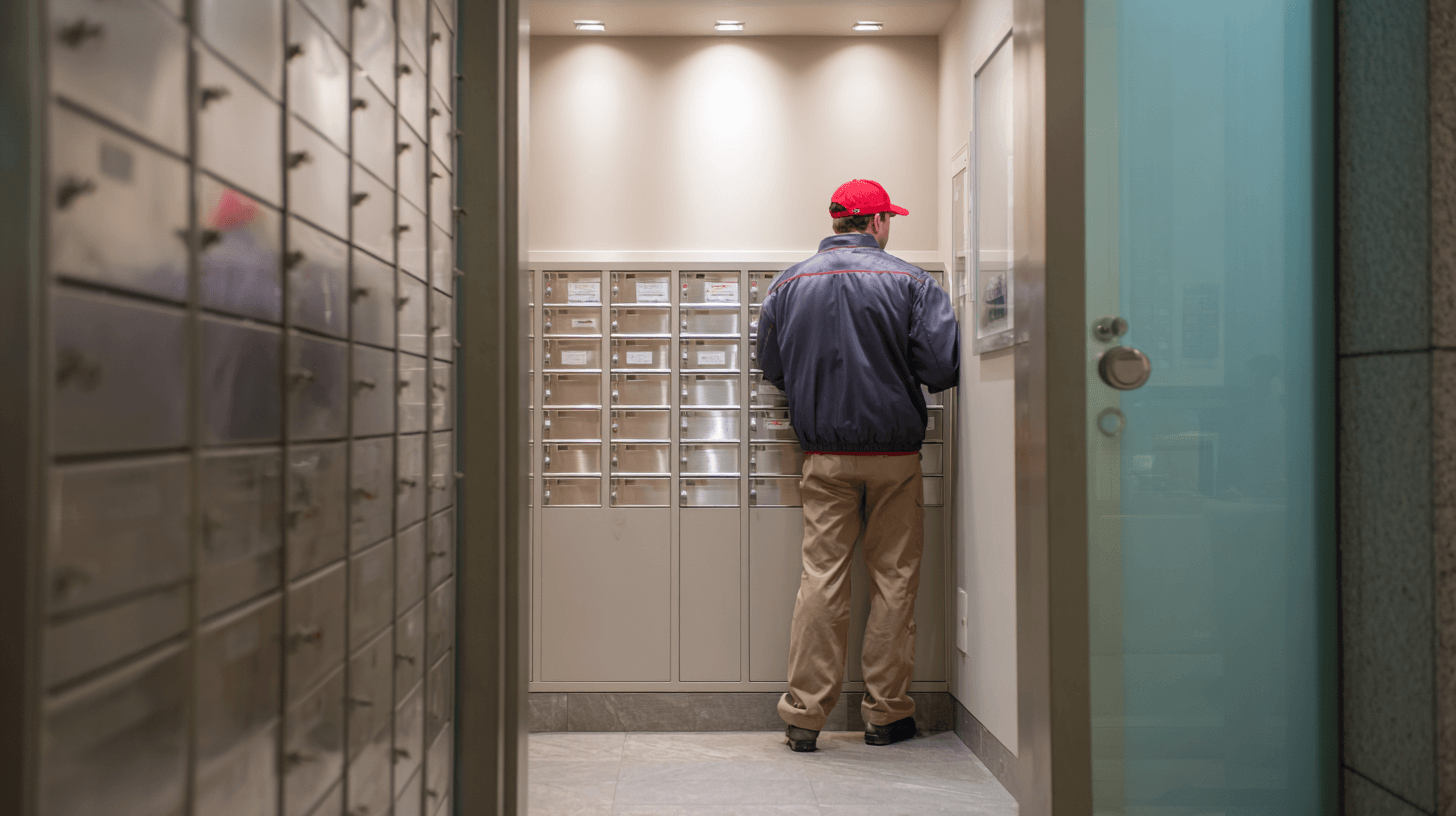
Package delivery is the daily friction point most operators underweight. KingsleySurveys benchmark data shows 15%+ of residents say package delivery services are inadequate. In higher-density mid-rise and high-rise buildings where deliveries are constant, that friction compounds.
The operational stakes are obvious. Mis-delivered packages, packages left in lobbies, theft from open mailrooms. All of it surfaces in resident reviews and leasing tours. The leasing agent who can show a tour group a controlled package room with smartphone-based entry is closing a deal that the one defending a wall of open cubbies isn't.
Access control overlaps directly here. Package rooms with credentialed entry, courier access workflows that scope delivery drivers to specific zones at specific times, and audit trails that prove who picked up what aren't bonus features. They're the difference between package handling being an asset and a liability.
Parking is the other infrastructure category residents only notice when it fails. The same benchmark data shows 1 in 5 residents are unsatisfied with parking in their community. That's a 20% problem on a routine residents repeat twice a day, every day, for the life of the lease.
For garden-style communities, parking and perimeter gates are essentially the same conversation. For mid-rise and high-rise communities, garage access and elevator credentialing tie together so closely that operators end up running them as a single system or fighting two in parallel.
Gate access control isn't a separate amenity. It's an extension of the access infrastructure that already handles #1.

Pools, fitness centers, clubhouses, business centers. These are among the most common amenities across the Grace Hill dataset, and they're also the amenities that don't show up meaningfully in rent correlation data. They've become baseline. Expected. Standard.
This doesn't mean they don't matter. It means they shape resident moments (the morning workout, the weekend pool day, the work-from-home stretch in the business center) without shaping resident decisions. They're the brochure photos. They earn the satisfaction score. They don't earn the renewal.
The best amenity is the one nobody mentions.
Which is why the most defensible amenity investment isn't usually another amenity. It's making sure residents can actually use the amenities you already have, with one credential, on the device they already carry.
The order holds. The application shifts.
Garden-style apartments lead with perimeter and unit access. Multiple gates, lean teams, and a long rekeying history make cellular-first hardware the highest-leverage investment a garden community can make.
Mid-rise, high-rise, and mixed-use buildings push the conversation up the stack to lobby, elevator, and amenity door credentialing. Apple Wallet and Google Wallet credentials consolidate everything onto the phone residents already carry. The same logic extends cleanly to the office floors inside mixed-use, where one credential for residents, employees, and visitors beats three competing systems.
Student housing plays the access category at extreme volume. Turn season compresses an entire year of credential changes into six weeks. Parents ask about audit trails before they ask about the gym. Gen Z residents treat access as table stakes and notice everything about a bad lockout.
Self-storage is the extreme case. There is no #4. Access is the entire amenity. A cloud-based access control system doesn't replace something. It is the entire product.
Senior communities raise the stakes on reliability. Smart access for older residents is a layered platform that handles residents, families, and home health aides without forcing everyone onto a single credential type.
Different verticals. Same ranking. Different surface.
Gatewise isn't on the amenity list. That's the point.
Gatewise handles #1 directly: gates, doors, credentials, audit trails. It supports #2 operationally: controlled package room entry, scoped courier access, exportable audit logs. It overlaps with #3: gate access, parking credentials, and garage entry on the same platform.
It also makes #4 better. Apple Wallet and Google Wallet credentials open every amenity door without an extra app, an extra fob, or an extra code. The fitness center, the pool deck, the rooftop, the business center, all of the amenities residents rate so highly become easier to actually use when the layer underneath them is invisible.
That's the frame. Gatewise isn't competing for a slot on the amenity list. It's making the amenity list work for residents.
If the top three amenities are the ones residents only mention when they break, then the complaints surfacing in your management portal aren't noise. They're the most valuable signal in your operation.
Every gate lockout, every credential failure, every package room friction point. That's the data residents would never volunteer in a satisfaction survey, captured by default the moment it happens. The operators who win the renewal aren't the ones who add another amenity. They're the ones who see the signal first and resolve it before it becomes a review.
That's the subject of Part 2 in this series: how to read what residents are quietly telling you through the Gatewise management portal, and what to do with what you find.
Because residents remember the amenities that make daily life work. The brochure ones rarely make the list.
Next in series: Part 2, on resident complaints and the management portal.
Gatewise offers a simple and modern gate entry system that provides residents with a mobile app and managers with a cloud-based management portal.