
It's 3:26 AM. A college student stands outside her dorm after a quick trip to the laundry room, patting her pockets in disbelief. Her key fob is sitting on her desk, and the front desk closed hours ago. She's facing hours in the cold—or an emergency locksmith bill that could cost her $75 to $200, with an additional $50 to $150 after-hours surcharge.
This isn't a hypothetical scenario. It's a reality playing out at student housing communities across the country every single night. And it's just one symptom of a larger problem: outdated access control systems that create security gaps, operational headaches, and frustrated residents.
For property managers overseeing garden style apartments, regional managers tracking net operating income across portfolios, and owners evaluating ROI on their investments, modern access control solutions represent one of the most impactful upgrades available today.
Understanding what is NOI in real estate starts with recognizing where operational costs bleed your bottom line. Traditional key fob systems create a constant drain through replacement costs, administrative overhead, and security vulnerabilities that impact your property's NOI meaning in real estate terms.
According to Angi's 2026 locksmith cost data, home lockout services typically range from $75 to $200, with emergency after-hours calls adding another $50 to $150 per visit. For students already managing tight budgets, a single lost fob can mean choosing between rent and groceries.
But the damage extends beyond individual residents. Every lockout call means staff time diverted from leasing activities, maintenance requests, and resident relations—all activities that directly impact what is net operating income and your property's financial performance.
Key fob replacement costs range from $50 to $150 per unit, according to industry pricing data. Multiply that across a student housing community with 200+ beds and annual turnover rates exceeding 90%, and you're looking at thousands of dollars annually in fob-related expenses alone.
Worse, physical credentials fail in predictable ways. Key cards demagnetize from everyday wear and proximity to phones. Fobs get damaged by water, dropped, or simply worn out. Students only discover these failures at the worst possible times—standing at a locked gate at midnight.
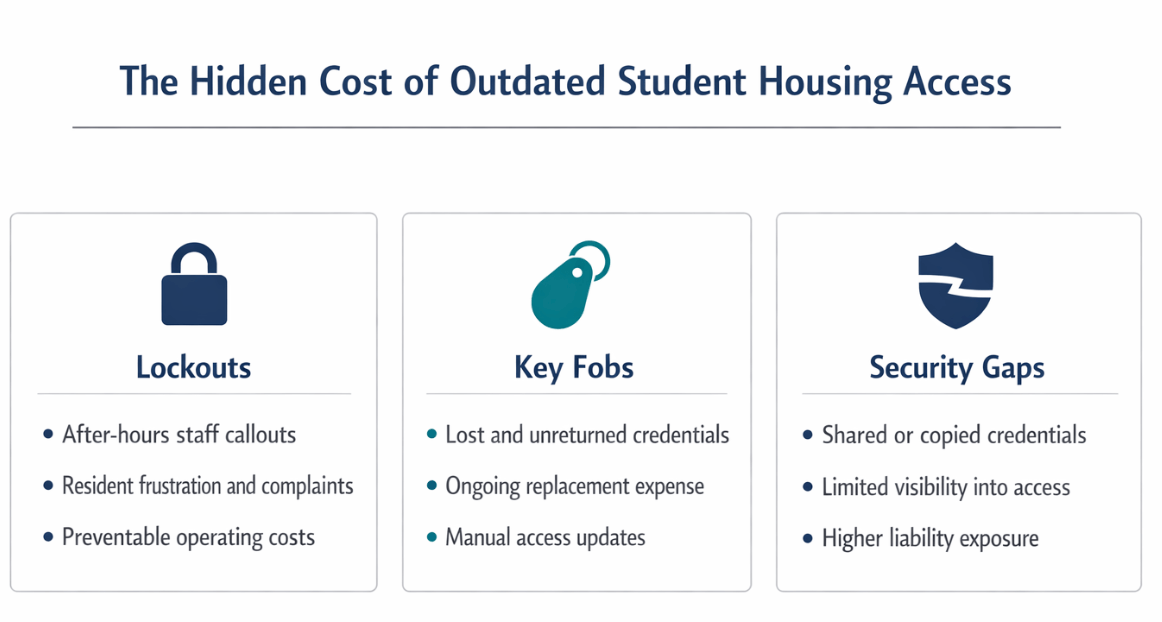
The consequences of inadequate access control extend far beyond inconvenience. Security breaches at student housing properties make headlines—and generate liability claims—with alarming regularity.
Students frequently prop open heavy fire doors for convenience, using wedges or other objects. According to fire safety research, 64% of premises visited by fire services were found using inappropriate methods to hold fire doors open. In student accommodation, this behavior creates dual vulnerabilities: compromised fire compartmentation and easy unauthorized access.
Combined with tailgating—where unauthorized individuals follow students through controlled doors—these behaviors explain why student housing communities experience higher rates of theft and security incidents. Traditional gate access control systems simply can't address these human factors.
Student housing theft patterns reveal that portable, high-value items—laptops, phones, gaming consoles—are frequent targets. Beyond the financial losses, victims experience anxiety, reduced sense of safety, and declining academic performance. For property managers, each incident means police reports, insurance claims, and difficult conversations with worried parents.
Without digital audit trails tied to individual identities, investigations rely on guesswork rather than evidence. Every lost key or unreturned fob becomes a potential security compromise that traditional intercom systems and call box setups simply cannot track.
Modern access control solutions replace vulnerable physical credentials with smartphone-based digital keys, transforming how student housing communities manage security while dramatically improving operational efficiency.
Mobile access control systems use secure digital credentials stored on smartphones to grant entry through Bluetooth or cellular technology. Cloud-based software validates each credential against an access control database and logs event details—user, door, and time—for comprehensive auditing. These commercial access control systems can cover unit doors, building entrances, gates, garages, and amenities from a unified platform.
For administrators, this means issuing, modifying, or revoking credentials remotely in seconds—no physical key management, no waiting for locksmiths, no garage door opener repair calls when residents can't access parking areas.
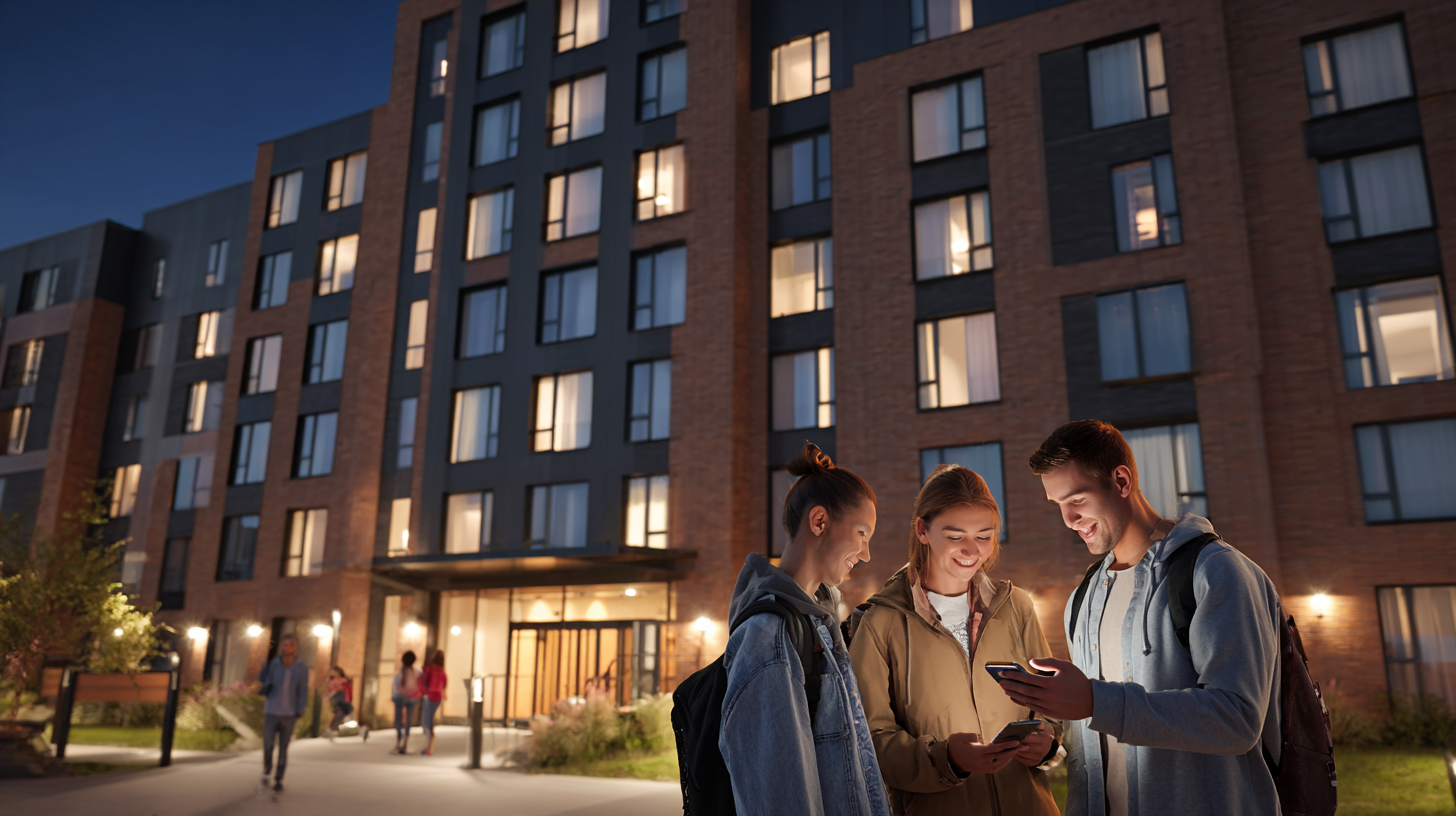
For residents, a smartphone is far less likely to be forgotten than a plastic key card. Digital credentials provision instantly on move-in and revoke immediately on move-out—no rekeying required. Mobile platforms support multifactor checks like PINs, fingerprints, or facial recognition, making them far more secure than traditional fingerprint door lock systems while offering superior convenience.
Temporary or guest passes with strict time windows enable secure visitor access, eliminating the security gaps that occur when residents share fobs with friends or leave doors propped for expected guests.
For operators, access logs provide detailed visibility into traffic at all controlled points, supporting investigations and compliance requirements. Integration with security camera installation systems allows residents to see and talk to visitors before granting entry—a critical feature for parent peace of mind.

Mobile credentials enable secure self-guided tours that expand leasing opportunities beyond traditional office hours—a game-changer for student housing communities competing for fall lease-ups.
Here's how it works: Prospects schedule a time slot and complete online ID verification. A time-bound mobile key grants access only during the tour window and only to specified doors—gate, model unit, amenities. The credential automatically expires after the viewing, preventing any unauthorized return access.
This virtual apartment tour capability transforms leasing operations. Properties report expanded showing hours, reduced staff time per tour, and increased lead-to-lease conversion rates by removing scheduling friction. For garden style apartments with sprawling layouts and multiple access points, self-guided tours solve the logistics challenge of showing units across large properties.
For regional managers and owners tracking NOI meaning real estate performance, modern access control delivers measurable returns across multiple categories.
Eliminating locksmith calls, fob replacements, and rekeying expenses creates immediate savings. Properties experiencing dozens of lockouts annually can redirect thousands of dollars back to net operating income. Rekeying a single lock costs $50 to $130, and full-unit rekeys for turnover can reach several hundred dollars—costs that disappear with digital credential management.
When access data integrates with building energy and automation systems, operators can optimize HVAC and lighting based on occupancy patterns. According to Multifamily & Affordable Housing Business, integrated access and energy systems can deliver up to 20% operational expenditure savings—particularly valuable in common areas where energy waste compounds quickly. Think of it as an uninterruptible power supply for your NOI.
Modern access technology serves as a premium amenity that justifies higher rents. Research shows that 85% of property owners with smart-equipped units report commanding 10% to 30% higher rents. For student housing competing against older properties, this differentiation can drive both occupancy and rental rates.
Access control needs vary significantly by property configuration. Understanding these differences helps property managers select solutions that deliver maximum value.
Properties with multiple buildings, spread-out layouts, and exterior entry points face unique challenges. Traditional wired systems require expensive infrastructure across large footprints. Cellular-based access control solutions eliminate this barrier by connecting gates, building entries, and amenities without costly network infrastructure—a critical advantage for properties where running cables between buildings isn't practical.
Mixed-use properties combining student housing with retail or commercial space require sophisticated access management. Residents need 24/7 access while commercial tenants and their customers operate on different schedules. Modern systems handle these complex scenarios through programmable access levels and time-based permissions that traditional call box systems simply cannot accommodate.
The condo vs apartment distinction matters for access control deployment. In rental communities, property management controls all access decisions. In condo environments, HOA boards must navigate owner preferences and voting requirements. Modern systems accommodate both models through flexible administrative structures that can be tailored to governance requirements.
Successful access control upgrades follow a phased approach that minimizes disruption while maximizing adoption.
Start with gate access control. Vehicle and pedestrian gates represent the highest-traffic access points and often create the most friction with traditional systems. Upgrading gates first delivers immediate resident satisfaction while building familiarity with the new technology.
Integrate with existing systems. Modern platforms connect with major property management software including Yardi, RealPage, and Entrata. This integration automates move-in/move-out credential management, eliminating manual processes and ensuring access changes happen the moment lease status updates.
Plan for resident communication. Students adapt quickly to smartphone-based access, but clear communication during rollout prevents confusion and support calls. Most properties find that younger residents prefer mobile access and actively request it over traditional fobs.
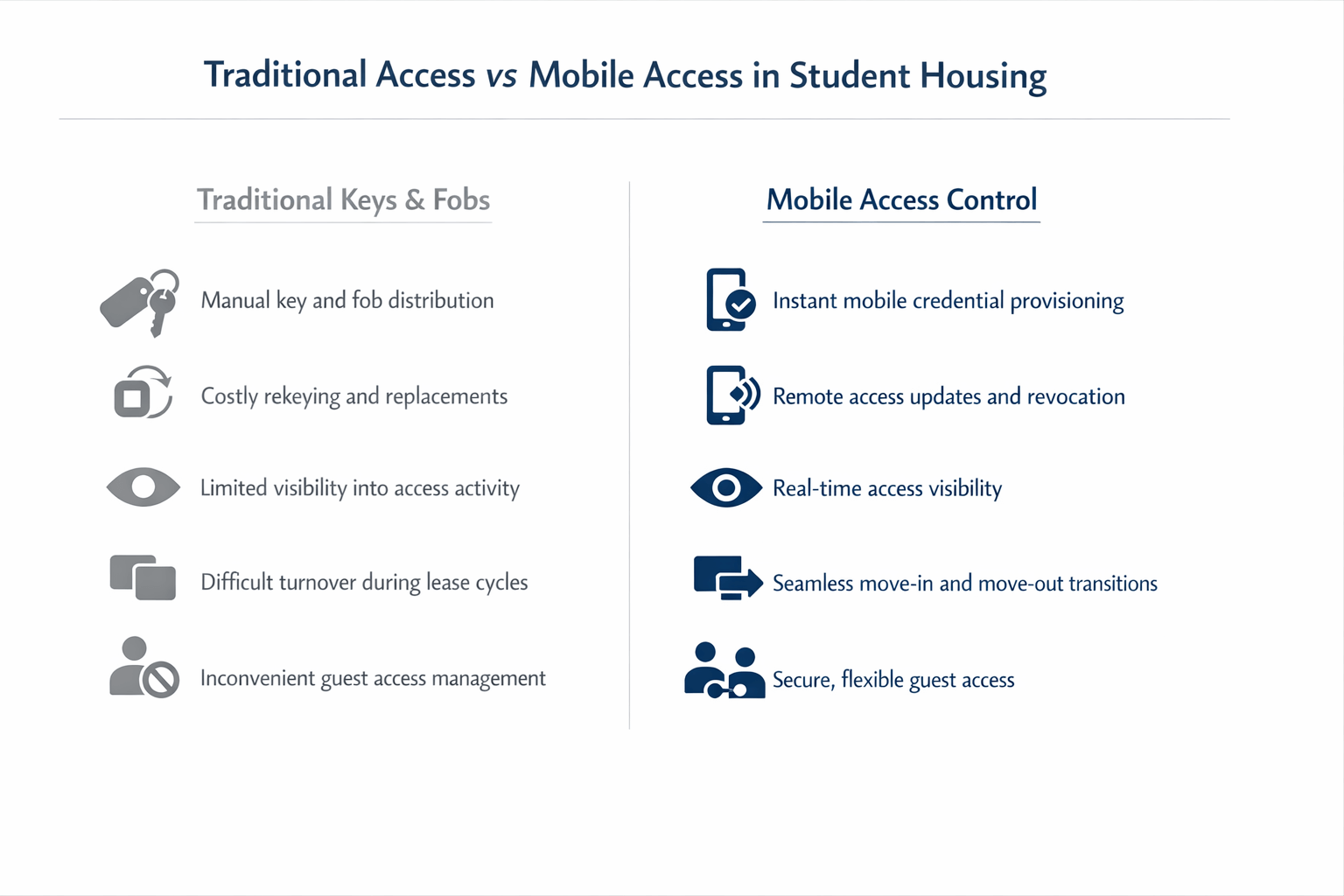
For property managers handling daily operations, modern access control eliminates countless friction points—no more midnight locksmith calls, no more manual fob programming, no more security gaps from lost credentials. For regional managers tracking portfolio performance, the NOI impact is measurable and meaningful. For owners evaluating capital improvements, access control upgrades deliver returns through both cost reduction and revenue enhancement.
The 3 AM nightmare doesn't have to be your property's reality. Modern access control solutions exist today that can transform student housing security while improving operational efficiency and protecting your investment.
The question isn't whether to upgrade—it's how quickly you can implement a solution that eliminates the vulnerabilities keeping you up at night. Book a demo to start now.
Gatewise offers a simple and modern gate entry system that provides residents with a mobile app and managers with a cloud-based management portal.