Your leasing agent just wrapped up her fifth back-to-back tour of the day. Meanwhile, three after-hours tour requests are sitting unanswered in the CRM, two prospects drove 45 minutes to the property only to realize they couldn’t get past the gate, and your best vacant unit—the corner two-bedroom with the killer natural light—hasn’t been shown in nine days.
That unit is costing you roughly $50 per day in lost revenue. Multiply that across every vacant apartment in your portfolio and the math gets painful fast.
Self-guided tours were supposed to fix this. And they can—but only when they’re built on a complete access control system that goes beyond the gate. The uncomfortable truth most operators are learning the hard way: letting a prospect through the community entrance and hoping they figure out the rest isn’t a touring strategy. It’s a liability.
This playbook breaks down exactly why smart unit locks are the non-negotiable layer that makes self-guided tours actually work—and how connecting your gate access control to unit-level security transforms your vacancy KPIs, conversion rates, and net operating income (NOI).
The apartment market in 2026 is operating in a fundamentally different environment than it was three years ago. A wave of new supply has changed the competitive equation, and the properties that win leases will be the ones that move fastest and offer the most frictionless prospect experience.
According to Duckfund’s analysis of multifamily market data, multifamily vacancy rates have been trending upward, hovering around 5.8% and approaching a stabilized range of 6% to 6.25% as markets normalize following pandemic-era lows. National rent growth has moderated to roughly 1% to 2.7%, tightening margins for every operator.
CBRE’s 2024 U.S. Multifamily Outlook projected 440,000 new apartment units in 2024 alone, with over 900,000 under construction—the biggest supply wave in decades. While CBRE’s 2025 outlook shows construction starts falling significantly below peak levels, the units already in the pipeline are now competing for the same pool of renters.
Meanwhile, Cushman & Wakefield’s Q4 2025 U.S. Multifamily MarketBeat reported that 2025 apartment demand totaled approximately 355,000 units—the third-highest annual absorption in 25 years. Demand is resilient, but with elevated supply, owners must compete more aggressively on experience and leasing speed to capture it.
Translation for every property manager, regional manager, and owner reading this: you cannot afford a slow leasing funnel. Every day a unit sits vacant is money evaporating from your NOI. NOI—or net operating income—is the single metric that drives property valuations, and it’s directly impacted by how fast you fill units and how efficiently you operate. In a market where rent growth alone won’t bail you out, operational levers like leasing velocity and conversion rate are the difference between a property that performs and one that bleeds.
The data on self-guided tours is no longer directional—it’s definitive. This isn’t a pandemic-era experiment. It’s the way modern renters want to shop for apartments.
According to ePropertyCare, citing National Apartment Association (NAA) data, properties that implemented self-guided tours saw a 40% increase in lead-to-lease conversion rates and a 60% reduction in leasing staff time spent on physical tours. The same analysis found that 80% of prospects prefer flexible touring options and 55% of tours occur outside standard business hours.
Think about that second figure for a moment. More than half of your touring demand happens when your leasing office is closed. Without self-guided tours, you’re invisible during peak prospect motivation hours.
Anyone Home’s leasing data reinforces the conversion story: prospects who completed a self-guided tour had a 54% higher conversion rate than those who only took an agent-led tour, and one in four self-guided prospects ultimately signed a lease. Perhaps most telling, 67% of prospects who leased after touring had completed a self-guided tour as their first interaction with the property.
AppFolio’s 2026 analysis frames it bluntly: speed is the number-one leasing metric right now, with 55% of renters expecting a response within two hours and over 66% of consumers preferring self-service options. Self-guided tours reduce Days on Market by enabling 24/7 on-demand access—turning your vacant units into always-available showrooms instead of locked boxes waiting for a Tuesday appointment.
Self-guided tours are no longer an innovative access control feature you showcase during NAA conferences. They’re the baseline that serious operators must deliver.
Here’s where the promise of self-guided tours breaks down for many properties: they’ve invested in gate access control and maybe a building entry system, but they’re still using traditional lockboxes or static codes to get prospects into actual units. It’s like installing a state-of-the-art alarm system on the perimeter and leaving the back door propped open with a brick.
Showdigs’ research on self-guided tour scams details real-world cases where fraudsters obtained lockbox codes—sometimes using stolen credit cards to book fake tours—and then reused those codes to run fraudulent rental listings, stealing deposits from unsuspecting renters. Even codes designed to be single-use can be exploited without robust identity verification and controlled access windows.
ThinkRealty’s analysis of self-showing risks highlights that property management agreements in some states explicitly acknowledge the risk, noting that unauthorized persons may gain access to properties using lockboxes, and that brokers do not insure against resulting theft or vandalism. The liability exposure is documented, not hypothetical.
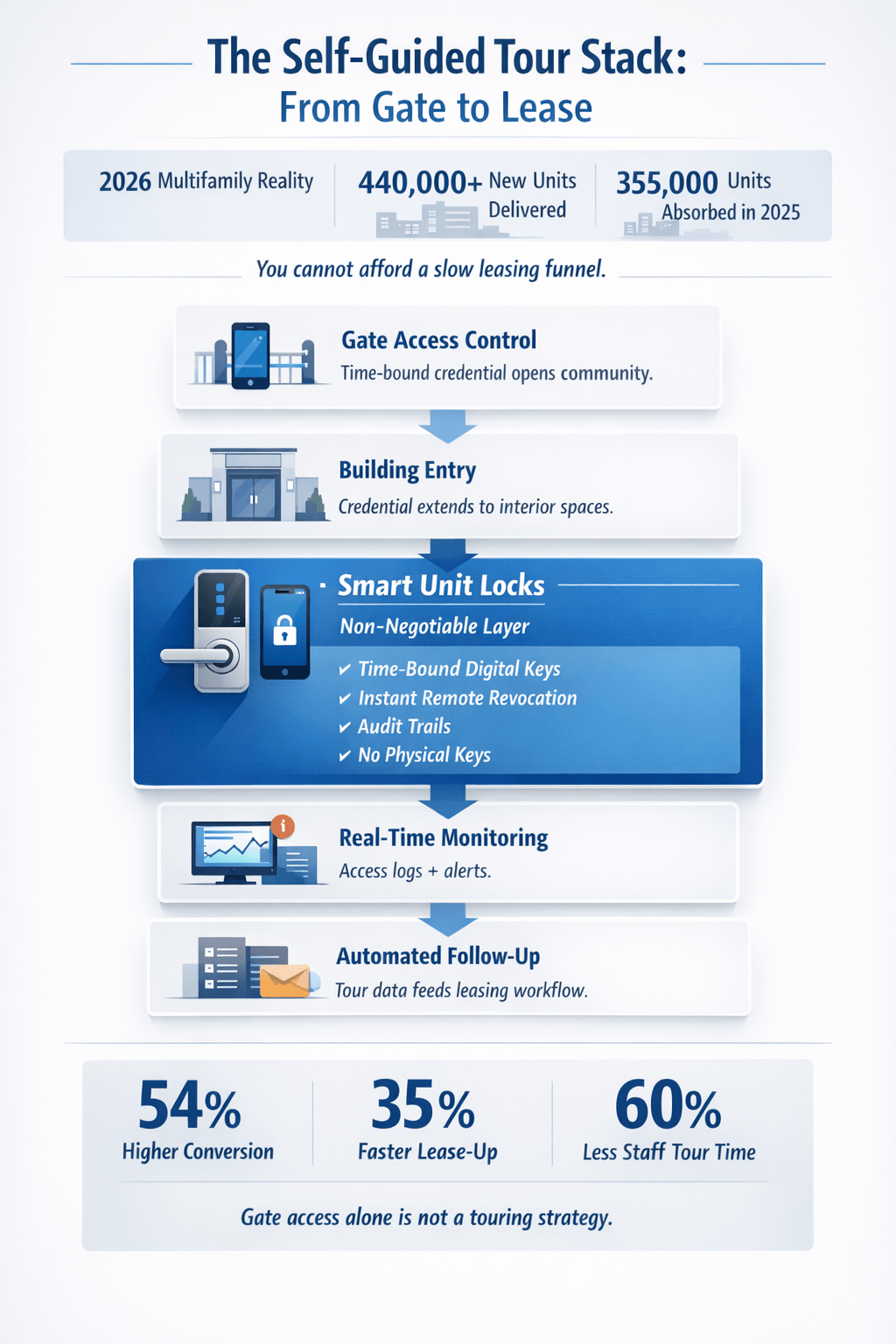
The core vulnerabilities of legacy lockbox approaches include codes that can be shared or reused after the scheduled tour window, no real-time visibility into who actually accessed the unit and when, limited ability to revoke access instantly if a prospect no-shows or a security concern arises, physical keys inside the lockbox that can be copied during the tour, and the inability to integrate with broader apartment security system infrastructure or property management software.
As Hemlane’s guide to self-guided tour safety argues, the real risk in self-guided touring isn’t the format itself—it’s cutting corners on security. Safe self-guided tours require a thoughtful access control stack, not simple static lockboxes.

When we talk about mobile access control for self-guided tours, we’re talking about replacing every vulnerability in the lockbox model with a secure, auditable, remotely managed credential system at the unit level.
Here’s what smart unit locks deliver that lockboxes fundamentally cannot:
Prospects receive a digital key—delivered via smartphone link, app, or QR code—that activates only during their scheduled tour window and expires automatically afterward. No physical keys to copy, no codes to share on social media, no access lingering past the appointment. According to ePropertyCare’s guide to mobile credentials, NMHC data shows 67% of residents prefer mobile credentials over traditional keys or cards—and prospects are no different.
A prospect no-shows? Revoke their access in seconds from your management portal. A security concern emerges during a tour? Lock the unit remotely. Your leasing agent doesn’t need to be on-site, drive across the property, or call a locksmith. As RemoteLock explains, smart locks with digital credentials allow property managers to update or revoke access instantly from anywhere.
Smart unit locks create timestamped records of every entry: who accessed which unit, when they entered, and by what credential method. iLOQ’s research on audit trail functionality describes how these logs integrate with property management platforms to resolve access disputes, support liability protection, and provide the operational oversight that insurance carriers and ownership groups increasingly demand.
According to RemoteLock, as many as 30–40% of U.S. apartment buildings still rely primarily on physical keys for unit doors. Every physical key is a potential security breach—keys get copied, lost, and passed to unauthorized individuals. Smart unit locks, including options like a fingerprint door lock or Bluetooth-enabled smart lock, replace this entire risk category with digital credentials that can’t be duplicated and leave a verifiable trail.
The real power of smart unit locks emerges when they connect to your tour scheduling software, CRM, and property management system. A prospect books a tour online, completes identity verification, and receives a time-bound mobile credential that grants access to the gate, building, and specific vacant units—all without staff intervention. After the tour, the system triggers automated follow-up workflows. This is what a modern best building management system looks like in practice: not a collection of disconnected tools, but an integrated stack that turns prospect interest into signed leases.
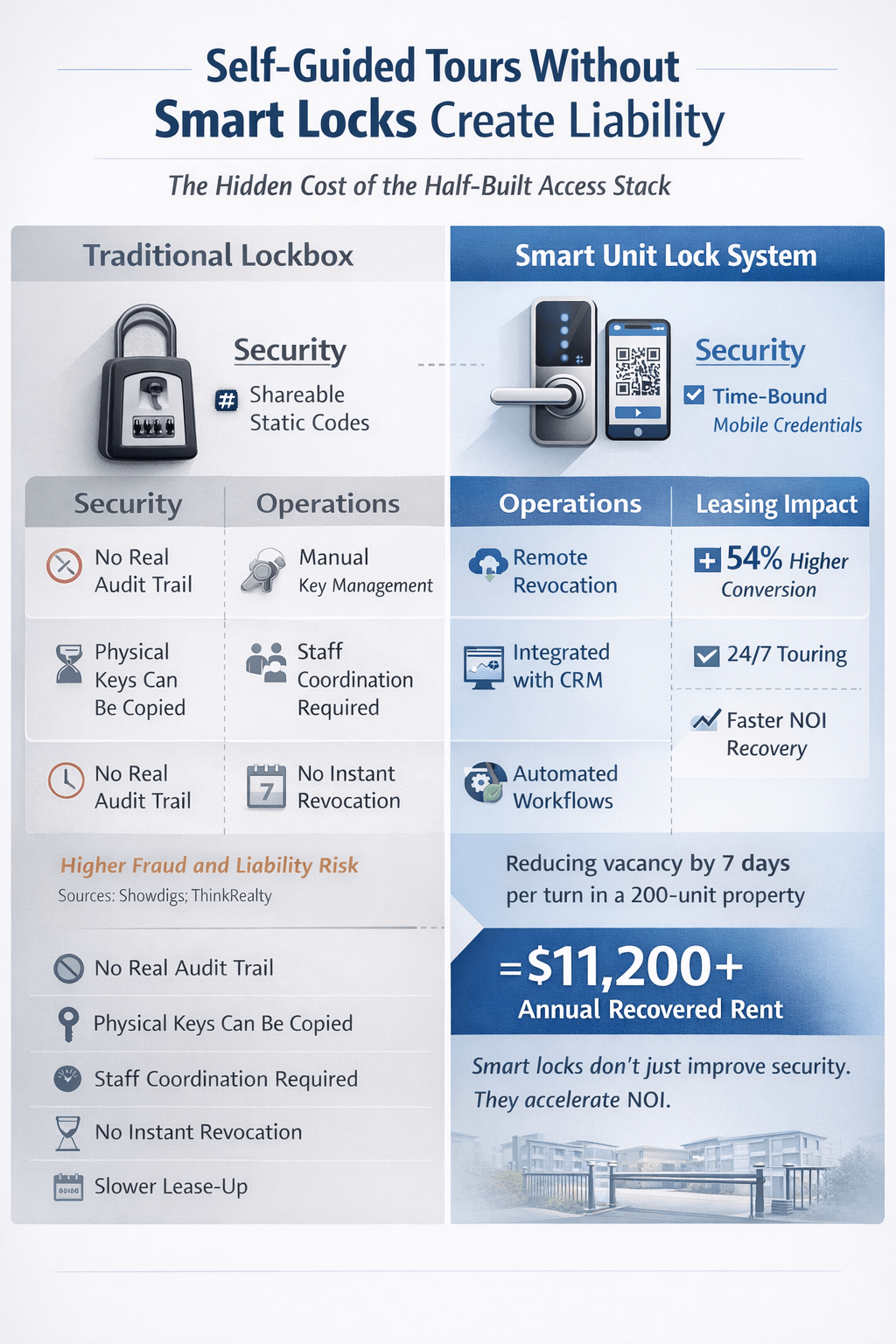
A self-guided tour that actually converts requires five connected layers working together. Gate access alone isn’t a touring solution—it’s just the first step.
Layer 1: Gate Access Control. The prospect enters the community through a smartphone-based gate system. No codes to fumble with, no call boxes that go unanswered. The system verifies the prospect’s identity and grants access only during the approved tour window. For garden-style communities with vehicle gates, this is the critical first touchpoint that determines whether a motivated prospect actually makes it onto the property.
Layer 2: Building Entry. For mid-rise and high-rise properties, the prospect needs to access the building itself—lobbies, hallways, elevators. The same mobile credential that opened the gate grants entry here, with access restricted to the floors and areas relevant to the tour.
Layer 3: Unit-Level Smart Locks. This is the layer most properties are missing and the one this entire playbook is built around. The prospect uses their mobile credential to unlock the specific vacant unit or units on their tour. The lock auto-secures after the tour window expires. No keys, no lockbox, no residual access.
Layer 4: Real-Time Monitoring and Notifications. Management receives real-time alerts as the prospect moves through the property: gate entry, building access, unit unlock, unit lock. Unusual patterns—like a prospect attempting to access a unit outside their window or a tour lasting significantly longer than expected—trigger immediate notifications.
Layer 5: Automated Follow-Up and Leasing Workflow. The moment the tour concludes, the system feeds data back into the CRM. Which units did the prospect visit? How long did they spend in each one? This intelligence powers personalized follow-up messaging and helps leasing teams prioritize the hottest leads.
As Gatewise’s self-guided tour overview explains, this end-to-end journey—from app-based qualification through automated access at gates, buildings, amenities, and units—is what separates a true self-guided touring platform from a basic entry system. Gate access alone is insufficient without integrated unit-level controls.
One of the biggest objections property managers raise about self-guided tours is security—and it’s a legitimate concern. Allowing strangers onto the property and into vacant units without staff present sounds risky. But the data shows that smart-lock-enabled self-guided tours are actually more secure than traditional lockbox methods, not less.
An integrated apartment security system built around smart unit locks addresses the specific security risks that keep regional managers and property owners up at night:
Preventing unauthorized return visits. Time-bound mobile credentials expire automatically. A prospect who toured Unit 203 on Tuesday cannot access it again on Friday—unlike a lockbox code that may remain active far longer than intended.
Protecting resident privacy. Smart access control ensures prospects can only access designated vacant units. There’s no risk of a prospect wandering into an occupied apartment, which is both a security incident and a resident satisfaction disaster.
Maintaining insurance compliance. Detailed audit trails provide the documentation that insurance carriers need to see. As ThinkRealty notes, legacy lockbox systems create documented liability gaps. Smart locks close them.
Identity verification before access. The best commercial access control systems for self-guided tours require ID verification as part of the booking process. Prospects verify their identity before they ever receive a credential, adding a layer of accountability that lockboxes simply don’t offer.
For regional managers evaluating a property management system comparison and property owners focused on capital efficiency, every technology investment needs to justify itself in operational metrics. Smart unit locks connected to a self-guided tour platform deliver measurable impact across the KPIs that drive NOI.
ePropertyCare’s analysis found that properties implementing self-guided touring technology experienced 35% faster lease-up rates. The mechanism is straightforward: when prospects can tour 24/7 instead of waiting for a weekday appointment, the time between initial interest and signed lease compresses dramatically. Hemlane reports a case study where a landlord who adopted smart locks saw average time-to-lease drop from 28 days to 14 days, supported by more than 320 self-guided tours with a 97% successful access rate.
The Anyone Home data is striking: a 54% higher conversion rate for self-guided tour prospects compared to agent-led-only prospects. When you combine frictionless access with the pressure-free environment of exploring a unit independently, prospects make more confident—and faster—decisions.
ePropertyCare reports a 50% decrease in weekend staffing needs and a 65% reduction in tour-scheduling time for properties using self-guided touring technology. That doesn’t mean you eliminate leasing agents—it means you redeploy them from repetitive tour-guide duties to high-value activities like closing deals, managing renewals, and building resident relationships.
With agent-led tours, your showing capacity is capped by staff availability. Self-guided tours remove that ceiling entirely. Saturday Properties described how implementing self-guided touring allowed them to run multiple simultaneous tours across five to six buildings, replacing the traditional one-agent-per-tour model and dramatically expanding capacity.
Every day a unit sits vacant costs money—not just in lost rent but in carrying costs, marketing spend, and the compounding effect of below-target occupancy on property valuations. When smart unit locks and self-guided tours cut your average days-on-market by even a week per unit, the portfolio-level NOI impact is substantial. For a 200-unit community with a $1,500 average rent and 8% annual turnover, reducing vacancy duration by seven days per turn saves roughly $11,200 annually in recovered rent alone—before accounting for reduced staffing overhead.

Garden-style properties are the ideal use case for the complete self-guided tour stack. Prospects need to navigate vehicle gates, walk across sprawling grounds, and access individual buildings and units. Without mobile access control at every layer, the prospect experience breaks down. Cellular-based gate access control is particularly critical here because many garden-style properties lack reliable WiFi infrastructure at perimeter access points.
Urban properties add complexity with lobby entry, elevator access, and floor-restricted credentials. Smart unit locks integrate into the same mobile credential system that controls the main entrance, allowing prospects to ride the elevator to the correct floor and access only the units designated for their tour.
The leasing cycle in student housing is compressed and intense—thousands of prospects during peak season, many touring with parents from out of town on tight schedules. Self-guided tours powered by smart locks dramatically expand touring capacity during these critical windows. The demographic is mobile-first by default, making smartphone-based access feel natural rather than novel.
Properties combining residential, retail, and office space require sophisticated access control that segments permissions across zones. A prospect touring a residential unit shouldn’t have access to commercial areas, and vice versa. Smart credential systems make this segmentation seamless. When evaluating any best commercial access control systems for mixed-use, this granular permission capability is non-negotiable.
Not every access control provider is equipped to deliver the complete self-guided tour stack. When conducting a property management system comparison for your communities, prioritize these capabilities:
Cellular connectivity that doesn’t depend on property WiFi. Self-guided tours need to work at gates, buildings, and units across sprawling properties where internet infrastructure is inconsistent. Systems that rely on on-site internet create single points of failure.
A single management portal for all access points. Managing gates through one vendor, building access through another, and unit locks through a third creates operational chaos. Look for a unified access control system that lets your team manage the entire touring journey from one dashboard.
Deep integration with property management software. Seamless connections with platforms like Yardi, RealPage, Entrata, and ResMan ensure that move-in/move-out data, unit availability, and resident records stay synchronized—critical for automatically enabling and disabling self-guided tour access on vacant units.
Flexible, transparent pricing. Multi-year contracts and hidden hardware costs work against portfolio flexibility. Look for providers that offer month-to-month terms and predictable per-access-point pricing.
Mobile-first design that requires no app download for prospects. Every app download requirement is a friction point that costs you tours. The best platforms deliver access via secure links or QR codes that work natively on any smartphone.
Gatewise is purpose-built for this use case. Gatewise’s cloud-based access control system combines cellular-connected gate hardware, a mobile app, and a management portal into a unified platform that supports the full self-guided tour stack—from community gate to individual unit. With deep integrations into major property management platforms and flexible 30-day contracts, it’s designed specifically for the operational realities of multifamily communities.
Gatewise’s approach to self-guided tours extends the same innovative access control that manages daily resident, guest, and vendor access into the leasing process. Prospects receive time-limited mobile credentials that work seamlessly from gate entry to unit access, while property teams get real-time monitoring and detailed audit trails through the management portal. For regional managers overseeing multiple properties, the centralized dashboard provides portfolio-wide visibility into touring activity, conversion patterns, and security events.
The multifamily industry has talked about self-guided tours for years. Most properties have some version of the capability. But the vast majority are still running a half-built stack—gate access without unit access, lockboxes instead of smart locks, manual processes where automation should live.
In a market where vacancy rates are elevated, rent growth is moderate, and supply keeps arriving, the properties that convert the highest percentage of prospect interest into signed leases will outperform. That conversion advantage doesn’t come from better marketing copy or shinier amenity spaces. It comes from removing every barrier between a motivated prospect and the inside of your best available unit.
Smart unit locks, integrated into a complete mobile access control platform that spans gates, buildings, and units, are how you remove those barriers—securely, at scale, and around the clock.
Your vacant units are waiting. Your prospects are ready to tour. The only question is whether your access control system will let them.
Schedule a Demo to learn how you can start accelerating your leasing funnel with fewer risks.
Gatewise offers a simple and modern gate entry system that provides residents with a mobile app and managers with a cloud-based management portal.