You manage fifteen properties across three states. It is 7:00 a.m., and your phone is already buzzing. A gate operator failed at your garden-style community in Austin. A resident at the Phoenix mid-rise is locked out because someone deactivated the wrong key fob. Your Houston property manager cannot pull last quarter's access logs because the vendor's portal went offline.
None of these problems are unique. But together, they reveal a deeper issue: when every property in your portfolio runs on a different access control system, with different vendors, different contracts, and different platforms, even routine operations become unpredictable. Budget overruns from emergency gate repairs compound with lost staff hours and inconsistent resident experiences, and the drag on net operating income is real.
The good news: the multifamily industry is at an inflection point. After years of slow, incremental change, the convergence of cloud-based management, mobile-first credentialing, and intelligent building systems is reshaping what access control technology can do for portfolio operators (Insights by Blueprint). Gatewise was built for exactly this moment: a single cloud-based platform that consolidates gate access control, amenity doors, and building entry across every community in your portfolio, giving regional and corporate teams the visibility, cost control, and security consistency they need.
Here is how it works, and why it matters for your bottom line.
If you oversee five, fifteen, or fifty properties, you already know the pain. When asked about access control solutions for multifamily portfolios, Mike DiBenedetto, CIO at Northland Investment Corp., put it plainly in a recent industry report: access control has changed very little for "centuries," but the industry is now in the middle of its digital transformation (Insights by Blueprint).
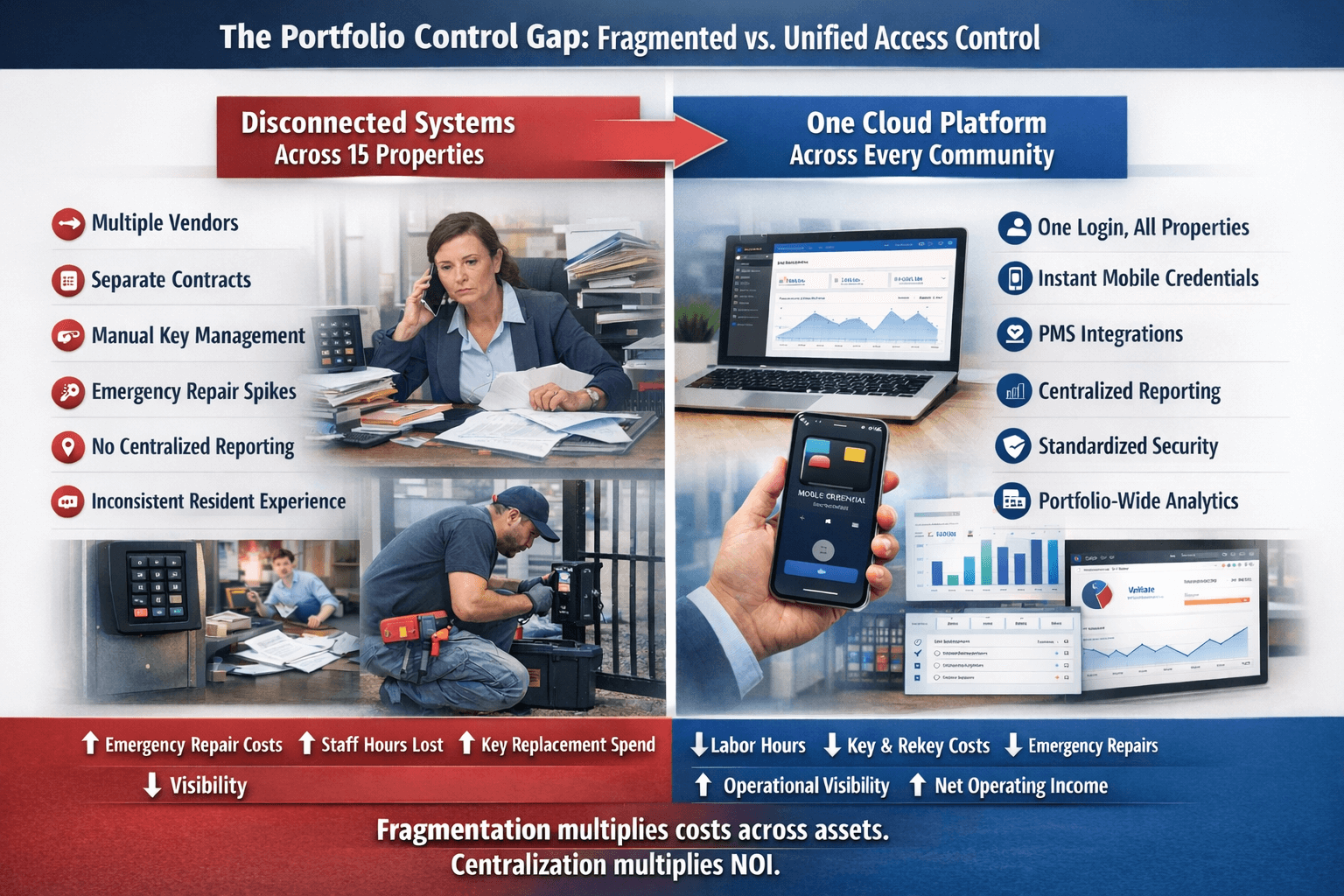
For regional managers, that transformation cannot come fast enough. The day-to-day reality of fragmented systems includes multiple vendor relationships (each with separate contracts and support lines), inconsistent resident experiences from one community to the next, unpredictable maintenance costs from aging gate hardware, manual key fob management that burns staff hours, and no centralized way to pull access logs or compare performance across your portfolio.
Every one of these friction points erodes net operating income, or NOI: the metric that property owners, asset managers, and investors scrutinize above almost everything else. NOI measures a property's total revenue minus operating expenses. When access-related costs spike (a gate repair here, a box of replacement fobs there, an emergency locksmith call at midnight), they chip away at margins that took months to build. For portfolio operators, these small losses multiply across every asset.
Modern, centralized access control solutions address these problems at the portfolio level, not just the property level.

Centralized access control means managing all entry points and permissions across your communities from a single platform, rather than having each building or system operate on its own. An industry guide to centralized multifamily access defines it clearly: all entry points (building entrances, amenity doors, parking gates, elevators, unit doors) are connected to one access platform, credentials and permissions are managed from a single dashboard, and events and audits are logged centrally, giving you a portfolio-wide view (iApartments).
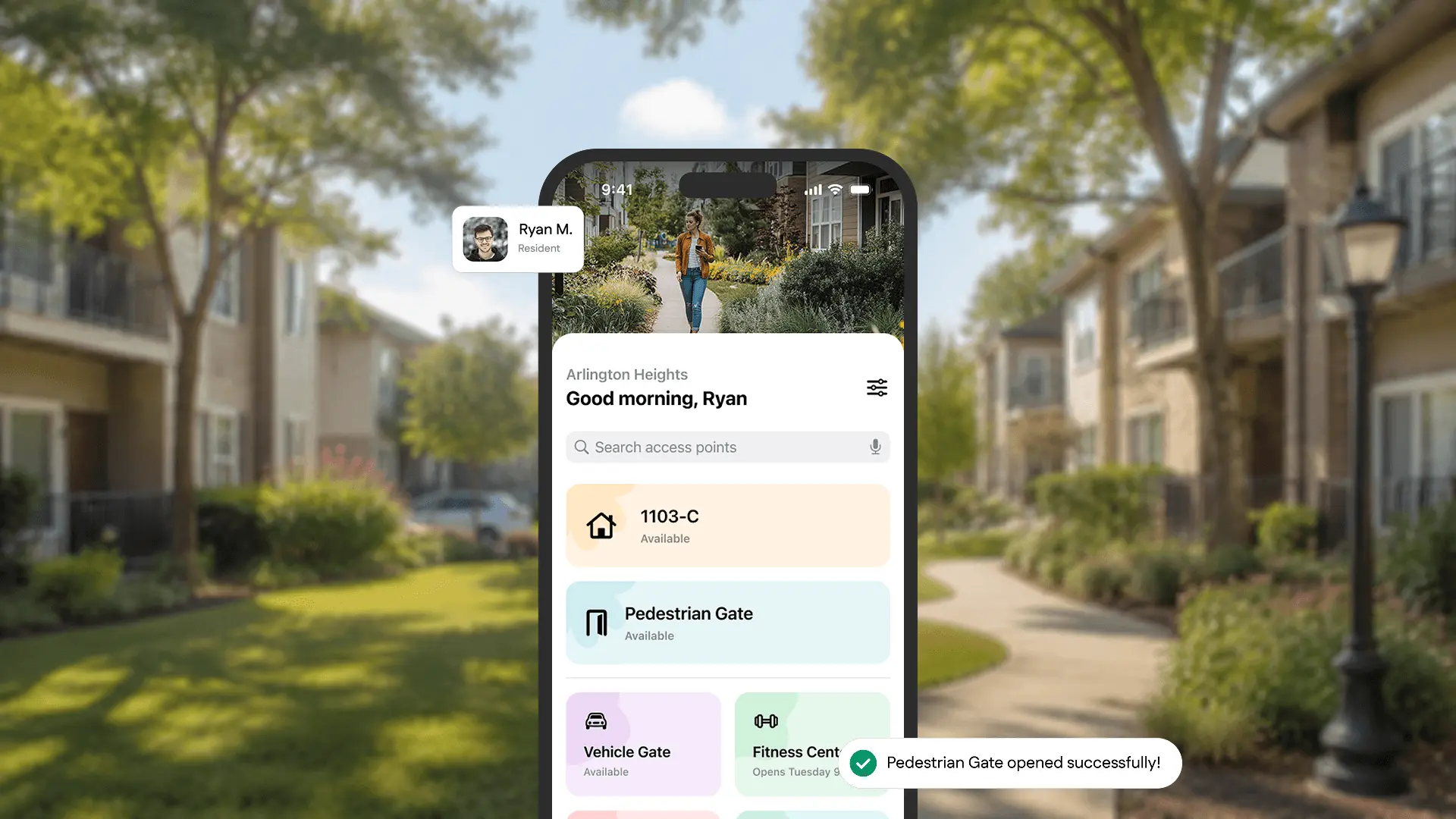
This is exactly the operational pattern Gatewise delivers. The Gatewise cloud platform lets regional teams monitor and control access for gates and doors from any location, manage multiple properties from a single interface, set customizable access permissions at the unit and amenity level, and view analytics that surface usage patterns across the portfolio (Gatewise).
Industry experts echo why this matters. Owners increasingly expect access control to sync seamlessly with core property management systems like Yardi, RealPage, Entrata, or AppFolio so that move-ins and move-outs automatically trigger credential updates. They also look for cloud-based architectures because, as one expert analysis puts it, they simplify remote management, reduce reliance on local servers, and make portfolio-wide expansion significantly easier (Insights by Blueprint).
For the regional manager, centralized control translates to practical wins every day: one login to check every property, standardized reporting for ownership and investors, instant access to any community's logs and activity, and the ability to onboard or offboard residents and vendors remotely without calling someone on-site.
Ask any regional manager what keeps them up at night, and unpredictable operating expenses will be near the top of the list. Legacy commercial access control systems are notorious budget busters: a gate operator fails and the unplanned repair bill lands on your desk, key fob replacements add up fast as units vanish faster than you can order them, and every rekeying event after a move-out means another invoice.
Cloud-based access control solutions fundamentally change this cost structure by shifting access control from irregular capital expenditures to recurring, subscription-based operating expenses, and by reducing the unscheduled work (rekeys, on-site visits, lockout calls) that drives budget volatility.
A case study from a leading owner/operator, Mark-Taylor Residential, shows what happens when centralized smart access is deployed portfolio-wide. Across a cluster of three centralized communities in Arizona, the operator measured the following results: 2,710 staff hours saved per year by eliminating key handoffs, rekeying, and manual tour setup; over $108,000 in annual payroll savings tied directly to smart access workflows; and self-guided tours that helped drive nearly $2 million in annual revenue from tour-to-lease conversions (iApartments).
Those outcomes are only possible when access is unified across buildings, roles, and systems, not when each community runs on its own siloed hardware and keys.
Beyond payroll, modern access control technology can lower total cost of ownership through risk reduction. A proptech analysis of multifamily total cost of ownership found that implementing advanced safety and security technologies can reduce insurance premiums by up to 20%, while systems like leak detection can prevent costly damages that average $10,000 per incident (SKBM Smart Tech). While those figures encompass broader smart-building technology, access control with centralized audit trails, instant credential revocation, and real-time alerts is a core piece of the security stack that insurers increasingly recognize.
For the portfolio operator, the takeaway is this: Gatewise helps shift access control from site-by-site hardware projects and reactive spending to a cloud-based portfolio platform with standardized, recurring costs, backed by industry evidence showing thousands of labor hours and six-figure payroll savings from centralized smart access.
Security inconsistency is one of the biggest risks a portfolio operator faces. When your Austin property uses a legacy gate panel, your Phoenix community relies on key fobs, and your Houston high-rise has a standalone intercom, you have three different security postures with three different vulnerability profiles.
Gatewise addresses this by merging security, automation, and mobile access control in a cloud-based platform that scales from a single building to an entire national portfolio. Core security capabilities include cloud-based management where operators can monitor and control gate and door access at all times from any location, mobile credentials (including Apple and Google Wallet integration) that eliminate physical keys and allow fast provisioning and revocation, customizable permissions at the unit and amenity level with temporary access for visitors and service providers, and integration with existing security systems alongside analytics that surface usage patterns (Gatewise).
The shift from physical keys to cloud-managed, mobile-first access is more than a convenience upgrade. It is a security upgrade. Industry data shows that 67% of renters are interested in or would not rent without keyless smart locks, according to the 2024 NMHC and Grace Hill Renter Preferences Survey (Broadband Communities). That demand is not just about convenience: mobile credentials are harder to duplicate, instantly revocable, and create automatic audit trails that physical keys never could.
Industry experts emphasize that mobile-ready, cloud-managed access is now expected as standard in multifamily because it enables instant credential activation and removal, real-time activity logs, and simplified access workflows that reduce on-site support needs (Insights by Blueprint). When a resident moves out at your Dallas property at noon, their access is revoked from the central dashboard before the moving truck pulls away, with no need to call anyone on-site, no fob to collect, and no rekeying to schedule.
For portfolios that include diverse property types (garden-style apartments, mid-rise, student housing, senior communities), consistent security policies pushed from a single cloud platform replace the patchwork of site-by-site settings that create gaps. Audit trails are centralized, compliance reporting is standardized, and emergency response (including instant portfolio-wide lockdowns if needed) happens from one interface.

Net operating income, often abbreviated NOI, is the single most important financial metric in multifamily real estate. It represents a property's total revenue minus operating expenses, and it directly determines property valuation, debt capacity, and investor returns. For regional managers, every dollar saved in operating costs and every dollar gained in revenue flows straight to NOI.
Modern access control solutions impact NOI on both sides of the equation.
Centralized mobile access control reduces or eliminates key fob and clicker replacement costs, emergency locksmith and gate repair calls, manual credential management labor, and vendor coordination overhead from managing multiple systems. As documented in the Mark-Taylor case study, a three-property cluster achieved over $108,000 in direct payroll savings and 2,710+ hours of recaptured staff time annually, simply by unifying access workflows (iApartments).
Modern apartment security systems and smart access directly support higher occupancy and faster lease-ups. Properties with modern technology amenities appeal to tech-savvy millennial and Gen Z renters who now represent the majority of the renter pool. The same Mark-Taylor case study showed that automated self-guided tours, enabled by centralized access, helped influence nearly $2 million in annual leasing revenue by extending tour hours and reducing friction in the prospect journey (iApartments).
The NMHC data reinforces this: renters are willing to pay a monthly premium for smart tech amenities including keyless locks, smart thermostats, and video doorbells (Broadband Communities). When your leasing agents can showcase smartphone-based gate access control and mobile entry during tours, it becomes a tangible differentiator that justifies premium rents and improves conversion rates.
One of the biggest advantages of a cloud-based access control system like Gatewise is that it works across the full range of multifamily asset types. Whether your portfolio includes garden-style apartments where sprawling layouts make wired systems impractical, mid-rise and high-rise buildings with controlled lobbies and elevators, student housing communities with high turnover and complex credentialing needs, senior living communities where simplicity and reliability are paramount, mixed-use developments with residential, commercial, and amenity access layers, or even self-storage facilities that need 24/7 contactless unit access, Gatewise's cellular-based hardware and cloud management portal handle each scenario from the same dashboard (Gatewise).
This versatility matters for portfolio growth. When you acquire a new property or add a development to your pipeline, standardized hardware and a consistent platform mean faster onboarding, simpler staff training, and no new vendor relationships to negotiate.

Transitioning a portfolio to centralized access control technology does not have to be overwhelming. Industry guidance recommends a phased approach that delivers early wins while building toward full standardization.
Step 1: Map your current access landscape. List every access point across your portfolio (gates, building entrances, amenity doors, garages). Document current systems, vendors, and pain points including lost keys, rekeying costs, lockout calls, and security incidents (iApartments).
Step 2: Start with a high-impact pilot. Choose two to three communities that represent your typical mix of property types and access scenarios. Standardize hardware and credential types, enable centralized access policies, and track KPIs such as hours saved, lockouts reduced, and maintenance cost changes.
Step 3: Measure, learn, scale. The Mark-Taylor pilot demonstrated that a three-property cluster was enough to prove the model, generating thousands of hours in savings and six figures in payroll efficiency (iApartments). Apply lessons from the pilot to each subsequent wave of communities using standardized playbooks for hardware, policies, and training.
Step 4: Integrate with your PMS. Gatewise integrates with major property management platforms including Yardi, RealPage, Entrata, and ResMan (Gatewise). Connecting access control to your PMS automates credential provisioning at move-in and revocation at move-out, which is one of the fastest ways to eliminate manual work and close security gaps.
Gatewise's flexible contract structure supports this phased approach: properties can be added or removed without multi-year commitments, so you can prove ROI before expanding (Gatewise).
The access control solutions market is crowded, and a property management system comparison quickly reveals that most platforms were designed for single-site operations or borrowed from commercial security and retrofitted for multifamily. Gatewise was purpose-built for multifamily communities from day one, with a particular strength in the property types that portfolio operators manage most: garden-style apartments and mid-rise communities where sprawling layouts, outdoor access points, and the absence of wired infrastructure make traditional commercial access control systems impractical.
The combination of cellular-based hardware (no WiFi required at access points), a cloud management portal with multi-property views, deep PMS integrations, and mobile access control through smartphone apps and digital wallets means Gatewise checks the boxes that industry experts say matter most: seamless integration with your tech stack, scalability across diverse property types, and a cloud-first architecture that simplifies remote management (Gatewise, Insights by Blueprint).
Fragmented access is a portfolio problem that requires a portfolio solution. Every day that your properties run on disconnected systems is another day of unpredictable costs, inconsistent security, and missed NOI opportunities.
Gatewise gives regional managers and portfolio executives a single platform to centralize gate access control, standardize your apartment security system across every community, and replace reactive spending with predictable operating costs, all while delivering the modern, mobile-first experience that today's renters demand.
Ready to see what centralized access control looks like for your portfolio? Schedule a demo and let us show you how Gatewise can transform operations across every asset you manage.
Gatewise offers a simple and modern gate entry system that provides residents with a mobile app and managers with a cloud-based management portal.