Most access control conversations in multifamily focus on two groups: residents and one-time guests. Senior housing operators know there is a third group that quietly drives more entries per day than either of them: the caregivers. Home health aides, hospice nurses, agency staff, physical therapists, and personal care workers move through senior communities on tightly scheduled, recurring visits, often across multiple units. They are not residents. They are not casual guests. And the access control systems most properties rely on were never designed for them.
That gap is becoming harder to ignore. Older Americans are aging in place at scale, the home care workforce is one of the fastest-growing occupations in the country, and the operational pressure on senior housing teams is climbing in step. The properties that get this right are reframing caregiver access as its own access control category, not a footnote on guest policy.
A family member dropping by once a week looks nothing like a caregiver who arrives every Monday, Wednesday, and Friday at 7 a.m. to assist three different residents on three different floors. The caregiver needs predictable, recurring access. They need it scoped to specific units or zones inside the building. They need it confined to defined time windows. And every entry needs to be logged, both for accountability between the agency and the family, and for liability if anything goes wrong during a visit.
Traditional approaches handle this badly. Issuing a fob to every agency worker creates a credential management nightmare and leaves operators with no clean way to deactivate access when a caregiver leaves the agency. Calling residents on the intercom every visit relies on residents being home, alert, and physically able to answer. Front-desk sign-in lobbies do not exist in most garden-style or mid-rise senior buildings. The result is either too much friction for legitimate caregivers, too much risk from unmanaged entry, or both at once.
The senior housing operators who solve this stop treating caregivers as a sub-category of guest and start treating them as a recurring user class with their own credentials, schedules, and audit requirements.

This is not a fringe operational issue. It is the leading edge of a much larger shift in how older Americans live.
The AARP 2024 Home and Community Preferences Survey found that 75% of adults aged 50 and older want to remain in their current homes as they age, and 73% want to stay in their communities. The same survey reported that about two-thirds (64%) say they will need a medical alert system and almost half (44%) say they need smart security features to live safely and independently. Aging in place is the dominant preference, and it requires infrastructure to support it.
The demographic backdrop is striking. The Population Reference Bureau projects that the number of Americans ages 65 and older will increase from 58 million in 2022 to 82 million by 2050, with their share of the total population rising from 17% to 23%. Pew Research adds that the number of Americans ages 100 and older is projected to more than quadruple over the next three decades, from an estimated 101,000 in 2024 to about 422,000 in 2054.
Those residents are not aging alone. The Bureau of Labor Statistics projects that employment of home health and personal care aides will grow 17% from 2024 to 2034, much faster than the average for all occupations, with about 765,800 openings projected each year. Every one of those workers is going to need a way into a building.
Senior housing operators are sitting at the intersection of these trends. The volume of recurring caregiver visits per property is going up, not down, and the pressure on operations to handle it cleanly is going up with it.
When operators evaluate access control systems through the caregiver lens rather than the visitor lens, the requirements list shifts. Five capabilities tend to matter most.
Recurring, time-bound credentials. A caregiver who visits Tuesday and Thursday from 9 a.m. to noon should have access only on those days, only during that window, only to the units assigned to them. Access control technology that supports schedule-based mobile credentials makes this trivial. Manual key fob systems do not.
Granular zone permissions. A home health aide assigned to a single resident does not need access to amenity spaces, mailrooms, or other floors. Access control solutions that allow operators to scope credentials by zone reduce risk without adding friction.
Audit-ready logs. Every entry and exit should be timestamped and tied to an identifiable credential. When a family asks why a caregiver was on site three hours longer than expected, or when an agency disputes billable hours, the access log is the answer.
Reliable connectivity. Senior buildings, especially garden-style and older mid-rise communities, were not wired for cloud-based proptech. Access control technology that runs on cellular and Bluetooth instead of wired internet at every door is far easier to retrofit. Gatewise's cellular-first architecture was built specifically for this case, eliminating the need for a phone line or internet at each access point.
Multiple credential types. Not every caregiver carries the same phone. Not every resident is comfortable with smartphone-only access. Apartment security systems that support mobile credentials alongside PIN codes, QR codes, and traditional fallbacks let operators meet caregivers and residents where they are.
.png)
The good news is that the technology to handle recurring caregiver access is already widely deployed in multifamily, just not always configured for senior housing’s specific needs.
Parks Associates research found that for many owners and operators looking at proptech investments, access control is the first area they examine, and that multifamily residents now rate the importance of security systems on par with a fitness center or gigabit internet. The same research highlights that next-generation solutions supporting mobile credentialing make it easier for residents to admit visitors compared with traditional call boxes.
For senior housing, that translates into a concrete operational playbook. Operators issue caregivers their own mobile credentials, scoped to specific units and time windows. Residents and families can review who has access and revoke it instantly when an agency rotates staff. Property managers can pull a per-resident access log on demand. And in older buildings without modern intercoms, a Virtual Call Box lets caregivers and visitors request entry and reach residents directly through their smartphones, without the hardware overhauls that traditional intercom replacements require.
Integration matters too. Access control technology that connects to property management systems like Yardi, RealPage, Entrata, and ResMan ensures that resident move-ins, move-outs, and unit transfers automatically update permissions. For senior communities where residents may transition between independent and assisted units, that automation prevents stale credentials from outliving the people they were issued to.
Most senior communities are not going to demolish a working access control system to start over. They do not need to. The modern playbook is a layered retrofit.
Start by mapping every entry point and identifying which doors and zones caregivers actually need to reach. Catalogue the recurring visitor types your residents receive: home health, hospice, physical therapy, agency aides, family members. Audit your existing hardware for compatibility with cellular and Bluetooth-based receivers. Then phase in mobile credentialing for caregivers and recurring vendors first, before expanding to all residents and guests.
Look for vendors that publish their integrations clearly, support 30-day contracts so you can pilot before scaling, and offer cellular-first architectures that do not require pulling new wiring to every door. The goal is to preserve the parts of your infrastructure that still work and replace only the layers that no longer serve a senior community where caregivers move through every day.
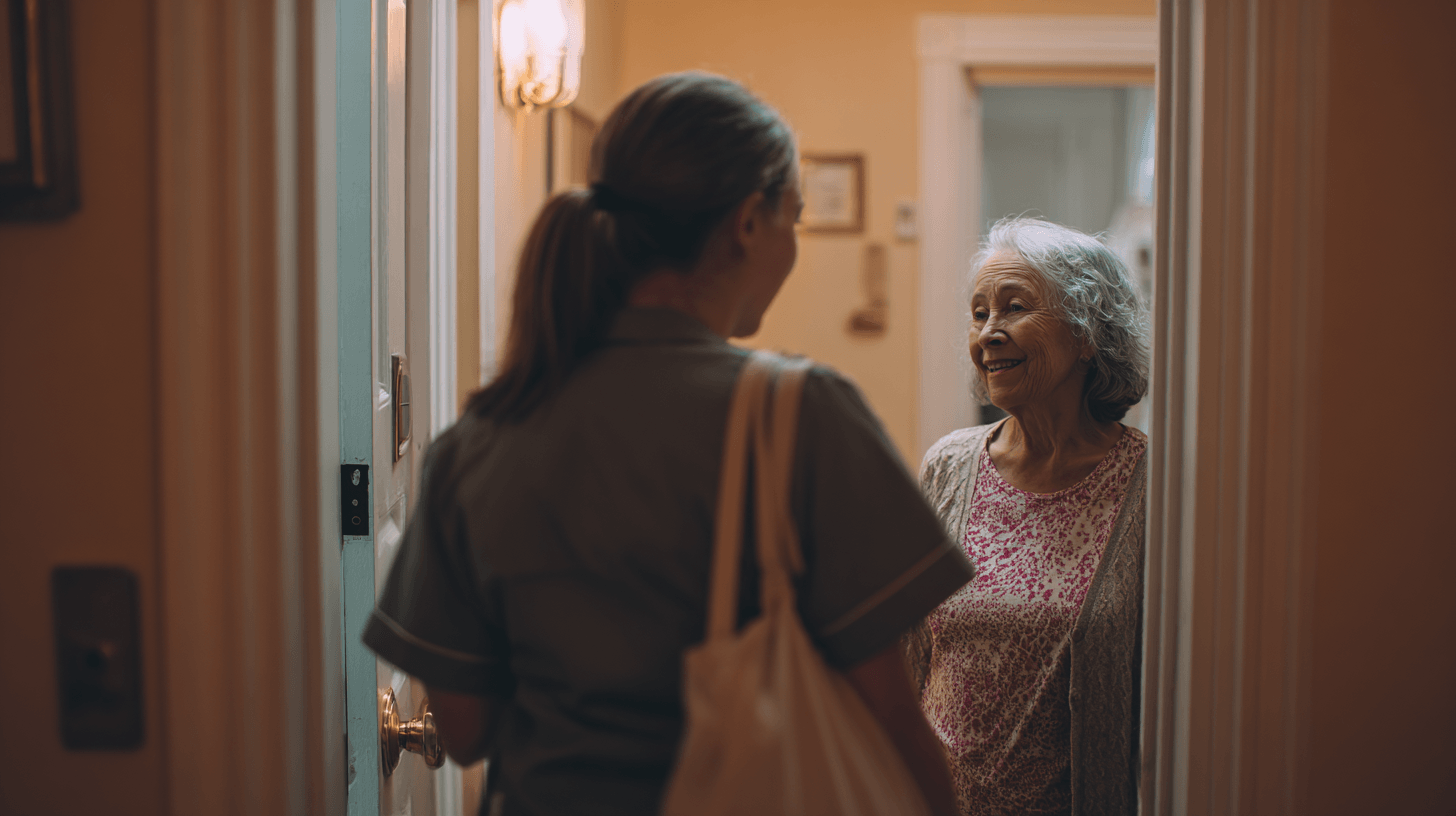
The conversation about access control in senior housing has been catching up to the reality on the ground. Residents want to age in place. Caregivers will keep arriving in larger numbers, on tighter schedules, across more units. The properties that recognize caregivers as a distinct access persona, and configure their access control systems accordingly, will run quieter operations, generate cleaner audit trails, and offer something residents and families notice immediately: a community that takes the people who keep them safe as seriously as the people who live there.
Ready to see how a cellular-first access control platform handles caregiver access for your senior community? Request a Gatewise demo to learn more.
Gatewise offers a simple and modern gate entry system that provides residents with a mobile app and managers with a cloud-based management portal.