
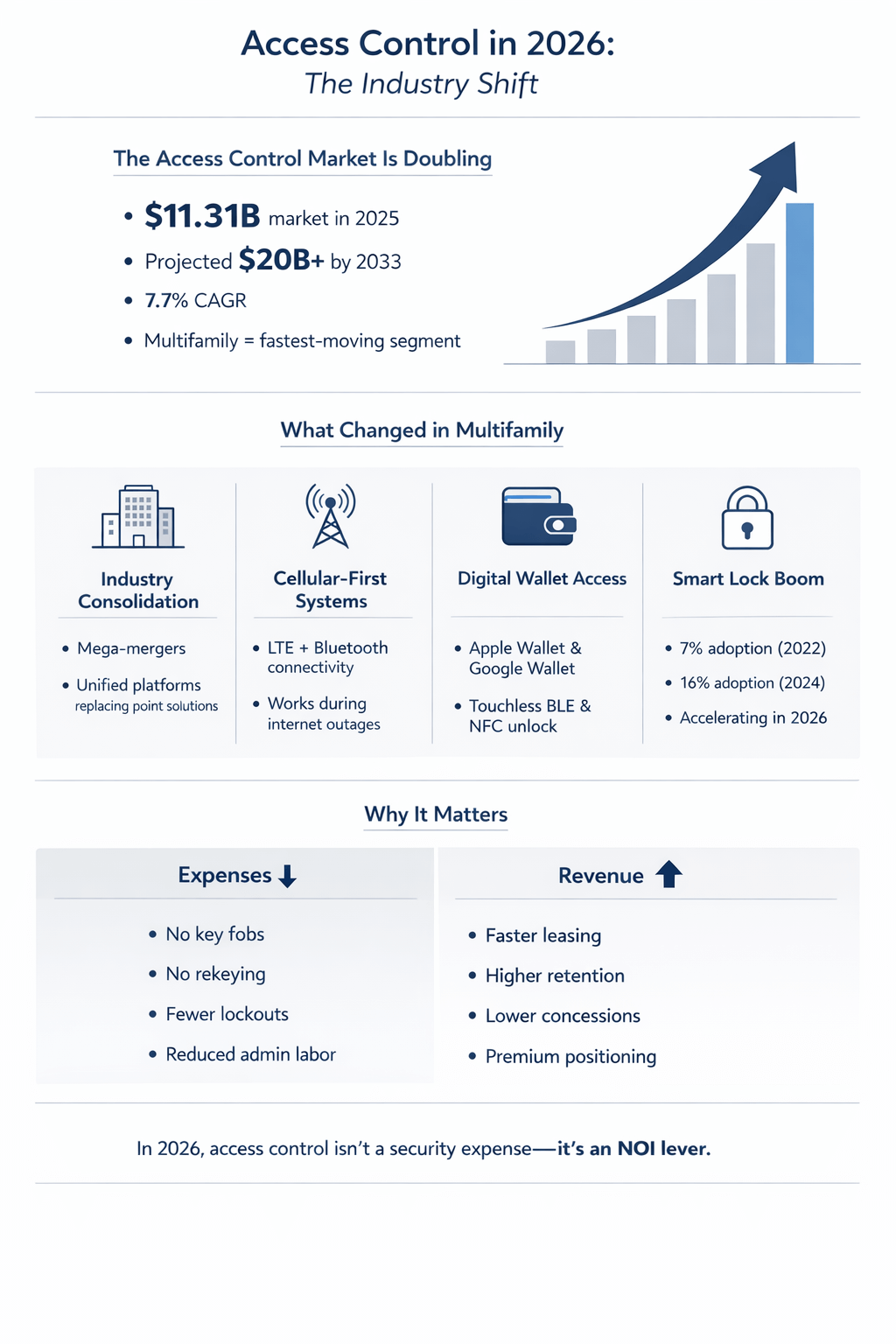
The access control landscape for multifamily housing looks nothing like it did even three years ago. Between sweeping industry mergers, the rapid adoption of mobile access control, and smart lock installations that more than doubled from 7% in 2022 to 16% in 2024, property teams are navigating a fundamentally different technology environment. Meanwhile, the broader access control market is valued at $11.31 billion in 2025 and is projected to exceed $20 billion by 2033, growing at a 7.7% CAGR—and the multifamily sector is one of its fastest-moving segments.
Whether you’re a property manager fielding 2 AM lockout calls, a regional manager benchmarking net operating income across a dozen communities, or an owner evaluating capital expenditures for the next fiscal year, this guide breaks down the trends, innovations, and competitive shifts defining access control solutions in 2026—and what they mean for your bottom line.
Before we look forward, it’s worth understanding the seismic moves that reshaped the competitive landscape for access control systems manufacturers throughout 2025.
The past year saw a flurry of consolidation among access control providers. Major cloud-based security companies merged to form larger unified platforms. Legacy commercial security divisions changed hands in deals worth tens of millions of dollars, transferring hundreds of thousands of apartment units to new operators. And at least one prominent smart lock brand completely rebranded itself as a “Building Intelligence” platform, expanding far beyond door hardware into HVAC automation, leak detection, and resident services.
What does this mean for property teams? The vendors you evaluated a year ago may no longer exist under the same name, and the platforms they offer may look dramatically different. For multifamily operators, this consolidation underscores a critical reality: the commercial access control system market is moving fast, and providers that specialize in apartment communities—rather than trying to serve every vertical—are better positioned to keep up with your needs.
These mergers aren’t happening by accident. The industry is converging around a clear trend: property teams no longer want to manage one vendor for gate access control, another for video surveillance, a third for visitor management, and a fourth for their intercom system. They want a single platform that handles it all. The companies that survived 2025’s consolidation wave are the ones building exactly that—and the ones that couldn’t keep up got acquired.

For garden style apartments and sprawling communities where running Ethernet to every gate is impractical—or where an uninterruptible power supply isn’t feasible at remote access points—cellular-first systems have become the gold standard. Gatewise uses LTE cellular connectivity paired with Bluetooth, meaning gates work even if local internet goes down. This is especially critical in hurricane-prone markets or communities where Wi-Fi infrastructure is unreliable. The result: no more frantic calls to your garage door opener repair vendor when a storm knocks out your network.
Apple Wallet and Google Wallet credentials are quickly moving from “nice to have” to table stakes. Touchless entry via BLE, NFC, or Wi-Fi is now standard among leading systems, letting residents wave their phone or smartwatch to unlock. For properties competing for tech-savvy Millennial and Gen Z renters—the demographics driving a 17% year-over-year increase in listing automation on platforms like Apartments.com—digital wallet support is becoming a differentiator in the condo vs apartment decision-making process.
The data speaks for itself: smart lock adoption in multifamily more than doubled from 7% in 2022 to 16% in 2024, and adoption rates have only accelerated heading into 2026. The best systems now cache permissions locally so residents aren’t locked out even if network connectivity drops. For communities evaluating fingerprint door lock options, biometric readers are increasingly available for fitness centers, package rooms, and amenity spaces—adding another layer of security beyond the smartphone.
Understanding what is NOI in real estate becomes critical when evaluating any capital improvement, and modern access control technology delivers measurable returns across several line items. For anyone asking “what is net operating income?”—it’s the revenue a property generates minus operating expenses, and it’s the single most important metric owners and regional managers use to evaluate property performance. Here’s how today’s access control solutions directly influence NOI meaning real estate teams care about:
Eliminating physical credential costs. Switching to mobile access control eliminates the recurring expense of key fobs, access cards, and rekeying. Many owners report savings of thousands of dollars annually on locksmith visits alone when residents turn over—no more changing locks or ordering replacement clickers.
Reducing operational labor. Cloud-based management means your team isn’t manually updating gate codes, distributing fobs at the leasing office, or driving across town to reset a system. Solutions that integrate with property management software like Yardi, RealPage, and Entrata automatically sync resident data during move-ins and move-outs, saving hours of administrative work each week. Gatewise’s native integrations with all four major PMS platforms—Yardi, RealPage, Entrata, and ResMan—make this seamless from day one.
Boosting occupancy and retention. Smart security amenities directly influence leasing decisions. Properties with modern apartment security system features—smartphone entry, guest management, intercom system upgrades—can differentiate in a market where over 30% of multifamily units are offering concessions to fill vacancies. The what is NOI impact here is twofold: reduced concession spend and improved resident stickiness.
Lowering insurance exposure. Upgraded security camera installation paired with access control audit trails can help properties demonstrate reduced risk to insurers. Detailed logs showing who entered which door and when provide documentation that legacy systems simply can’t match.
Artificial intelligence is moving from buzzword to practical application in access control systems. Smart analytics can now reduce false alarms by as much as 75%, focusing alerts on genuine security events like tailgating or forced entry rather than a resident propping a door for a pizza delivery. As AI-powered access control gains popularity in multifamily buildings, expect capabilities like anomaly detection, predictive maintenance alerts, and voice-activated emergency lockdowns to move from novelty to standard features.
Traditional call box hardware—those metal panels bolted to gate posts—is giving way to QR-based, hardware-free alternatives. Gatewise’s Virtual Call Box is leading this shift: visitors scan a QR code at the gate to connect with residents through their smartphones, eliminating the need for expensive intercom panels that corrode, jam, and require constant maintenance. For properties weighing a full intercom system overhaul, virtual call box solutions offer a dramatically lower-cost entry point while delivering the modern experience residents expect.
The concept of “building intelligence”—where access control technology connects to HVAC, lighting, leak detection, and resident services—is moving from concept to deployment across the industry. Forward-thinking platforms now automate routines like adjusting thermostats and restricting access when units become vacant, reducing energy waste and turnover labor simultaneously. For mixed-use developments managing both commercial tenants and residential units, this convergence eliminates the need for siloed, single-purpose systems that create extra work and points of failure.

The field of access control systems manufacturers serving multifamily has never been more crowded. But here’s the thing most enterprise security companies won’t tell you: a system designed for corporate offices, warehouses, or retail storefronts won’t handle the unique demands of apartment communities.
Multifamily is different. You’re dealing with high resident turnover, hundreds of guests and delivery drivers per week, maintenance and vendor scheduling, leasing agent workflows, and the specific infrastructure challenges of garden style apartments with remote gates spread across a campus. A generalist commercial access control system treats these as edge cases. A purpose-built multifamily solution like Gatewise treats them as core functionality.
Pricing transparency is winning. The market is moving toward predictable, subscription-based pricing. Cloud access management fees typically range from $20 to $50 per door per month across the industry, though models vary—some charge per access point, others per unit, and some bundle everything into flat-rate plans. Properties are increasingly gravitating toward providers that offer transparent, all-inclusive pricing without lengthy contracts. Gatewise’s month-to-month flexibility and straightforward per-access-point pricing were designed with exactly this expectation in mind.
Integration depth matters more than feature lists. The winning access control solutions in 2026 aren’t necessarily the ones with the longest spec sheets—they’re the ones that integrate deeply with property management software to automate workflows. When your access control systems talk to Yardi, RealPage, Entrata, and ResMan, the operational savings compound: new residents get instant access, departing residents lose it automatically, and your leasing agents spend their time closing deals instead of programming fobs.
Based on current trajectories, here’s what multifamily teams should prepare for:
Self-guided tours will become standard leasing infrastructure. Access control providers are increasingly building tour-specific credential management directly into their platforms, allowing leasing teams to issue time-restricted virtual apartment tour passes that grant prospects secure entry without a staff member present. As self-guided touring technology matures, the line between access control and leasing operations will continue to blur—and properties without this capability will fall behind.
Cybersecurity will move to the foreground. As AI-powered access control systems gain popularity in multifamily buildings, privacy and data protection are becoming front-of-mind for both residents and regulators. Property teams will need to clearly communicate what data their apartment security system collects, how it’s used, and who has access to it. Providers with bank-level encryption, SOC 2 compliance, and transparent data policies will have a competitive edge.
Energy management and access control will converge. With residential electricity rates increasing more than 30% on average since 2020, smart access systems that tie into HVAC and lighting controls—automatically adjusting when units are vacant—will deliver direct utility savings that boost NOI meaning for ownership groups tracking every dollar.
The cellular-first model will expand beyond gates. Gatewise’s approach—using LTE cellular connectivity rather than requiring on-site internet—is proving especially valuable for properties in areas prone to outages or with sprawling campuses where hardwired infrastructure is cost-prohibitive. As more access control systems manufacturers recognize the limitations of Wi-Fi-dependent architectures, expect cellular and Bluetooth dual connectivity to become standard across pedestrian doors, amenity spaces, and package rooms.

With so many options, how do you cut through the noise? Whether you’re exploring innovative access control for a new construction lease-up or retrofitting a 200-unit community, focus on these criteria:
Multifamily specialization. A system designed for office buildings won’t handle the unique challenges of apartment living—high turnover, guest management for hundreds of units, maintenance and vendor access scheduling, and the specific demands of garden style apartments with remote gates spread across a campus. Gatewise was built from the ground up for exactly these scenarios.
Offline reliability. Ask the hard question: what happens when the internet goes down at 11 PM on a Friday? Gatewise’s cellular-first architecture means your gates keep working regardless of your property’s Wi-Fi status—no outage, no lockout, no emergency call to your maintenance team.
Integration depth. Confirm native connections with your property management platform. The best access control solutions don’t just pass data—they automate entire workflows around move-ins, move-outs, and lease changes.
Total cost of ownership. Look beyond the monthly subscription. Factor in installation costs, hardware warranties, credential fees, and what happens if you need to add access points as your portfolio grows. Gatewise’s transparent pricing and month-to-month contracts mean no surprises and no long-term commitments.
Support responsiveness. When a gate stops working at your busiest property during move-in weekend, response time matters more than any feature on a spec sheet.
The access control industry is in the middle of a generational transformation. The mergers of 2025, the doubling of smart lock adoption, and the rise of building intelligence platforms all point in the same direction: multifamily properties that invest in modern, cloud-based mobile access control now will be better positioned to attract residents, retain them, and protect their net operating income in an increasingly competitive market.
For operators who’ve been watching from the sidelines, 2026 is the year the cost of inaction starts outweighing the cost of investment. The technology is proven. The pricing is transparent. And the residents walking through your gate access every day? They’re already expecting it.
Ready to see how Gatewise’s cellular-first, mobile access control platform can transform your community? Schedule a demo today and discover why apartment communities nationwide trust Gatewise to simplify operations, enhance security, and elevate the resident experience.
Gatewise offers a simple and modern gate entry system that provides residents with a mobile app and managers with a cloud-based management portal.