
Ask an operator why they are still running fobs, keypads, or a gate that fails every winter, and the answer is rarely "we like it." The answer is that replacing it sounds like a project. A capital line. A week of disruption. A stack of new logins for a team that is already stretched thin. So the friction stays, because living with it feels cheaper than fixing it.
We wanted to test that assumption against evidence, so we went to the people best positioned to settle it: customers who had just switched. This post is built on their answers.
The status quo is worse than most operators admit. In an earlier Gatewise customer survey, 92% of communities reported access control challenges before switching, and about half of them called those challenges significant. The rest called them occasional, the intermittent kind of friction that never quite justifies a project but never quite goes away either.
That is not a Gatewise-specific pattern. It is the industry baseline. Grace Hill's KingsleySurveys benchmark, drawn from more than seven million residents, found that 1 in 4 rate controlled access to their apartment as below average. Unreliable access is not the exception. It is the starting condition for a large share of communities.
So why do operators wait? Not because they doubt the destination. The research on what happens after the switch is unambiguous. They wait because the transition feels like the expensive part. The real barrier to better access control is almost never the platform. It is the fear of the switch.
That is exactly the fear the onboarding data dismantles.
After onboarding, Gatewise asks new customers a simple question: how was the experience of getting set up? In our most recent onboarding survey, the average rating came back at 9.9 out of 10. The vast majority gave it a perfect score, and not a single response came in below a 9.
Numbers that high usually invite a shrug, so it is worth being precise about what they measure. This is not a rating of the product after a year of use. It is a rating of the hardest, most-dreaded moment in the entire relationship: the changeover itself, the week operators brace for. The moment most likely to generate a complaint is the moment customers scored close to perfect.
The written comments explain why. Three themes ran through nearly every one: it was fast, it was easy, and there was a real person on the other end. Those are the three things operators are actually afraid of losing when they switch. Here is what each looked like in practice.
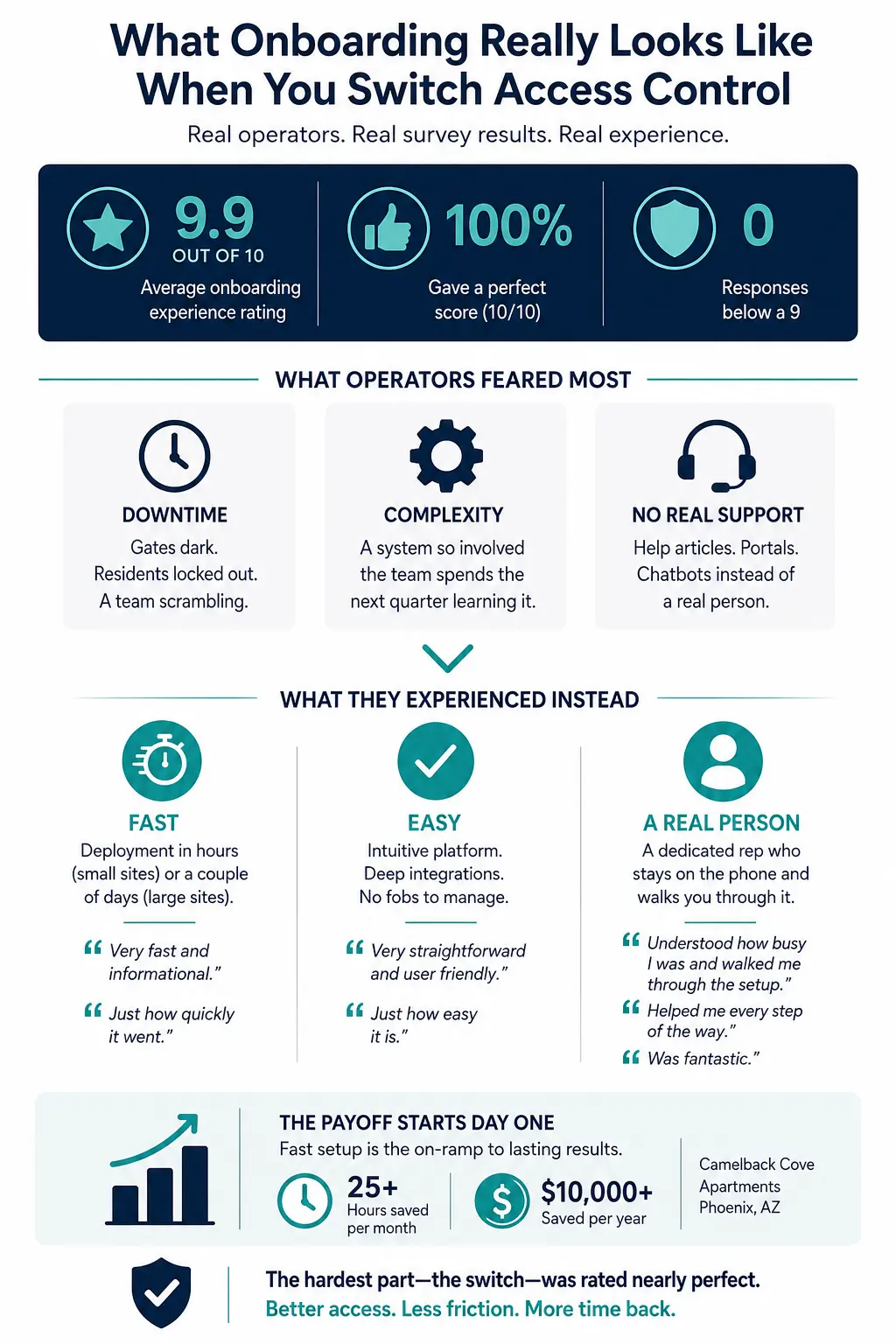
The first fear about switching access control is downtime: gates dark, residents locked out, a team scrambling. In the survey, speed was the single most common thing customers volunteered. They described the rollout as "very fast and informational," and more than one simply marveled at "just how quickly it went."
That speed is built into how deployment works, not into any one community's luck. Installation runs in hours for smaller setups and a couple of days for larger systems, because cellular-first hardware does not require running internet to each gate or door. The switch is a low-disruption project rather than a construction event.
The payoff on the other side is just as concrete. Camelback Cove Apartments, a garden-style community in Phoenix, saves its staff more than 25 hours a month and roughly $10,000 a year after consolidating access onto Gatewise. The fast setup is not the prize. It is the on-ramp to the time the team gets back every month afterward.
The second fear is complexity: a system so involved that the team spends the next quarter learning it. Customers reported the opposite, calling the platform "very straightforward and user friendly" and, again and again, pointing to "just how easy it is."
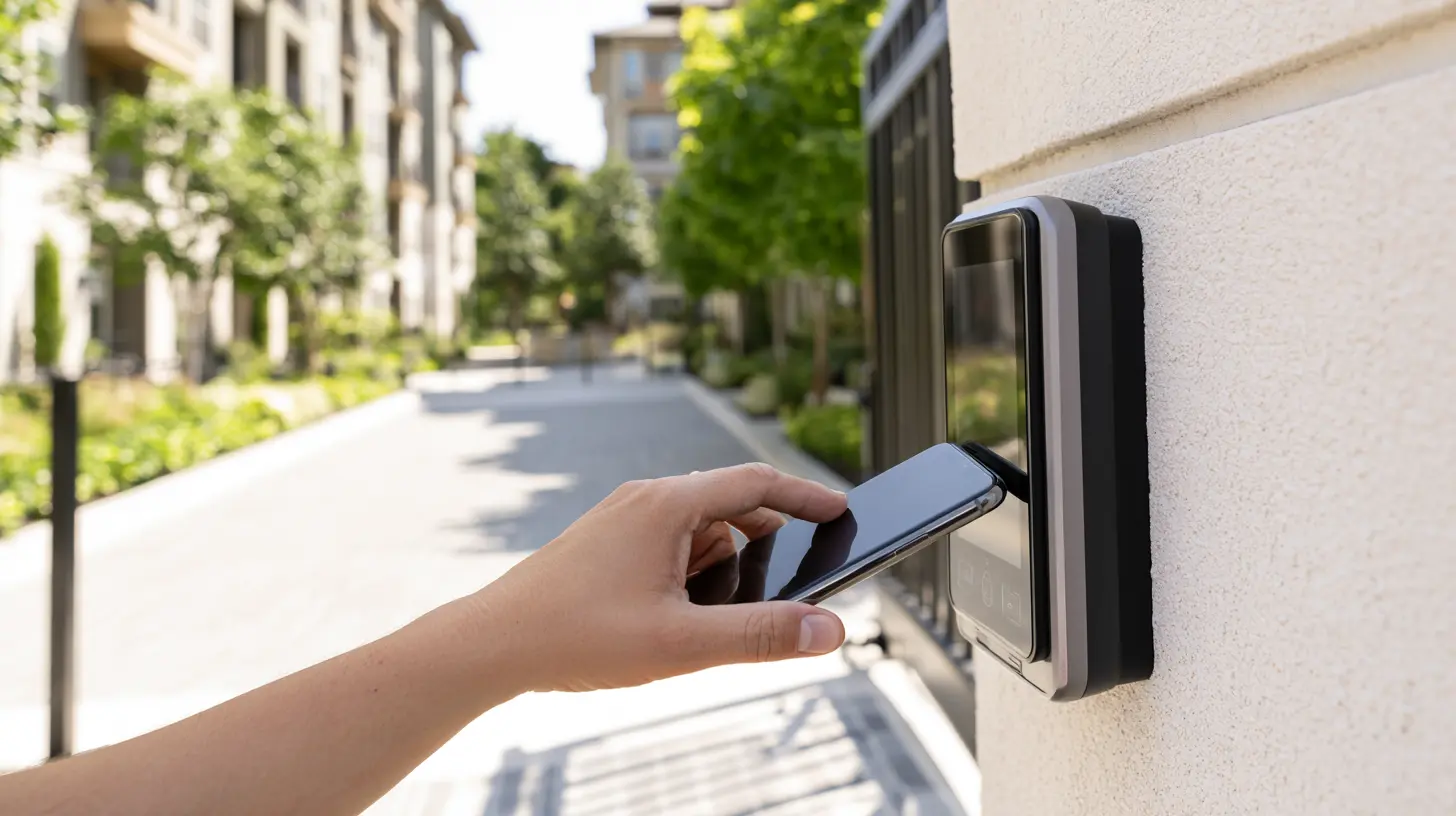
Ease is not a personality trait of the software. It comes from removing the manual steps that make legacy systems tedious. Deep integrations with the major property management systems keep resident credentials accurate on their own, so the move-in and move-out steps that used to generate errors and follow-up calls stop generating them. And because residents access the community with the smartphone and mobile wallet they already carry, the team is not handing out, tracking, and replacing a drawer full of fobs. Less to administer on day one means less to administer every day after.
Here is where the survey got specific, and where the story stops being about software at all. When customers were asked what stood out, most of them did not point to a feature. They pointed to a person.
Over and over, the comments described the same thing: a Gatewise representative who "understood how busy I was onsite and walked me over the phone through the setup," who was "very supportive throughout the onboarding process" and "helped simplify the information to ensure it was a smooth transition," who "helped me every step of the way and was very patient with me." One customer boiled the value down to "staying on the phone and walking me through how to get everyone set up and how to navigate through the Gatewise portal." Another kept it simple: their representative "was fantastic."
Read those back and notice what they are describing. Not a help article. Not a chatbot. A person who stayed on the phone, understood that the manager had a full day already, and carried them through it.
This is customer success treated as part of the platform rather than an upsell. Every Gatewise customer gets it, at every tier, regardless of community size: support for the residents using the app, 24/7 support for the team running the portal, and onsite help for the hardware. In a category where implementation is usually where the friction starts, a real person on the phone is what turns a good install into a result that holds.
That matters beyond the warm feeling. It is the same reason the amenity series found that results last: the support is what keeps the system working after the install team is gone.

A single smooth onboarding is a nice anecdote. What makes it a strategy is that the same experience repeats, whether the next site is a mid-rise across town or a self-storage facility in another state.
The survey is not multifamily-only. A self-storage operator described the same thing the apartment communities did: "customer service was always helpful and kind when I needed it." For a facility running lean or remotely, that consistency is not a bonus. It is the whole point, because dependable, well-supported access is the enabling layer for the unstaffed and remote-managed operating model that defines modern self-storage. The tenant experience and the operator's setup experience both have to be simple, and both were.
For a regional manager, that repeatability is the entire value. One smooth onboarding is a good week. The same onboarding across every community and facility in the portfolio, on one portal with one set of workflows, is a standard. The switch does not get harder as the portfolio gets bigger. It gets more familiar.
For a community manager, the headline is the one the survey delivered: the switch was fast, it was easy, and someone competent was on the phone the whole time. A dreaded week turned out to be a good one.
For a regional manager, it is that same experience, made consistent across every site, so standardizing on one platform stops being a risk and starts being a relief.
For an owner or operator, the line runs straight to the number that matters. The transition is the barrier that keeps better access control off the table, and removing that barrier unlocks the returns underneath it: a 20% lift in resident satisfaction with controlled access at Gatewise communities versus 7% at non-Gatewise communities in the same markets, and a 16.5% stronger link between access control and renewal intent, measured across 649 properties over three years. Retention is the single largest lever on NOI for most communities, which makes this the most NOI-friendly kind of investment: the kind that protects rent rather than chasing it. To put real figures against your own portfolio, the ROI calculator is the place to start.
The amenity series made a single argument: the amenities residents quietly depend on, not the ones they brag about, decide the renewal, and access is the one they use most. The obstacle to acting on that has always been the same, and it has never really been the product. It has been the fear of the switch.
The operators who just made that switch scored it 9.9 out of 10 and told us why in their own words: it was quick, it was simple, and a real person carried them through it. The part everyone dreads turned out to be the easy part.
The question was never whether better access control is worth it. The data settled that. The question was whether getting there is as hard as it looks. It is not.
Continue the series: What Changes When Access Control Just Works and the data behind the 20% satisfaction lift. Or browse more customer success stories.
How long does it take to switch to smart access control? It is a low-disruption project rather than a construction event. Installation typically takes hours for smaller setups and a couple of days for larger systems, in part because cellular-first hardware operates over cellular networks and does not require running internet to each gate or door.
Is switching access control disruptive to residents and staff? Customers consistently report the opposite. In Gatewise's latest onboarding survey, speed and simplicity were the two most-cited experiences, and retrofit-friendly deployment keeps existing infrastructure in place where it is working, so the changeover does not force a full rip-and-replace.
What kind of support do I get during onboarding? A Gatewise representative guides the setup, and three layers of customer success are included at every tier, regardless of community size: support for residents in the app, 24/7 support for the team in the management portal, and onsite help for hardware. Survey respondents repeatedly credited that hands-on, by-phone guidance as the thing that stood out.
Do I have to replace my existing gate hardware? Not necessarily. Gatewise integrates with existing gate operators and access points where they are reliable, and where hardware is at end of life, replacement is straightforward and matches the same retrofit-friendly approach.
What did customers actually say about onboarding? In Gatewise's most recent onboarding survey, the average rating was 9.9 out of 10. Comments centered on three themes: how quickly it went, how straightforward it was, and how helpful the customer success team was throughout the process.
Does onboarding work the same way for self-storage? Yes. A self-storage operator in the survey reported the same helpful, responsive experience the apartment communities did, which matters because dependable, well-supported access is core infrastructure for unstaffed and remote-managed facilities.
How does onboarding scale across a portfolio of communities? The same setup experience repeats site to site, with every community and facility managed from a single portal with one set of workflows. For regional teams, that consistency is what turns standardizing on one platform into a low-risk decision.
Is the switch actually worth it? The returns are well documented. Gatewise communities saw a 20% lift in resident satisfaction with controlled access versus 7% at non-Gatewise communities in the same markets, and a 16.5% stronger link to renewal intent across 649 properties over three years. You can model the impact on your own portfolio with the ROI calculator.
The hardest part of better access control is deciding to start. Book a demo, and we will walk you through the rest.
Gatewise offers a simple and modern gate entry system that provides residents with a mobile app and managers with a cloud-based management portal.