
Most property owners track rent growth, occupancy, and expense ratios down to the decimal. Yet many overlook one of the fastest-growing revenue lines in multifamily: technology fees tied to smart access control systems. Specifically, monthly "door fees" charged for mobile entry, digital wallet credentials, and smart unit locks are creating a high-margin income stream that flows straight to the bottom line.
This is not theoretical. Across garden style apartments, mid-rises, student housing, and mixed-use communities, operators are discovering that residents will pay for the convenience of smartphone-based access when it clearly replaces old pain points like lost keys, lockouts, and clunky fob systems. And the impact on net operating income is substantial.
For anyone new to the metric: net operating income (NOI) is total property revenue minus operating expenses, calculated before debt service and capital expenditures. It is the single most important number for valuing income-producing real estate.
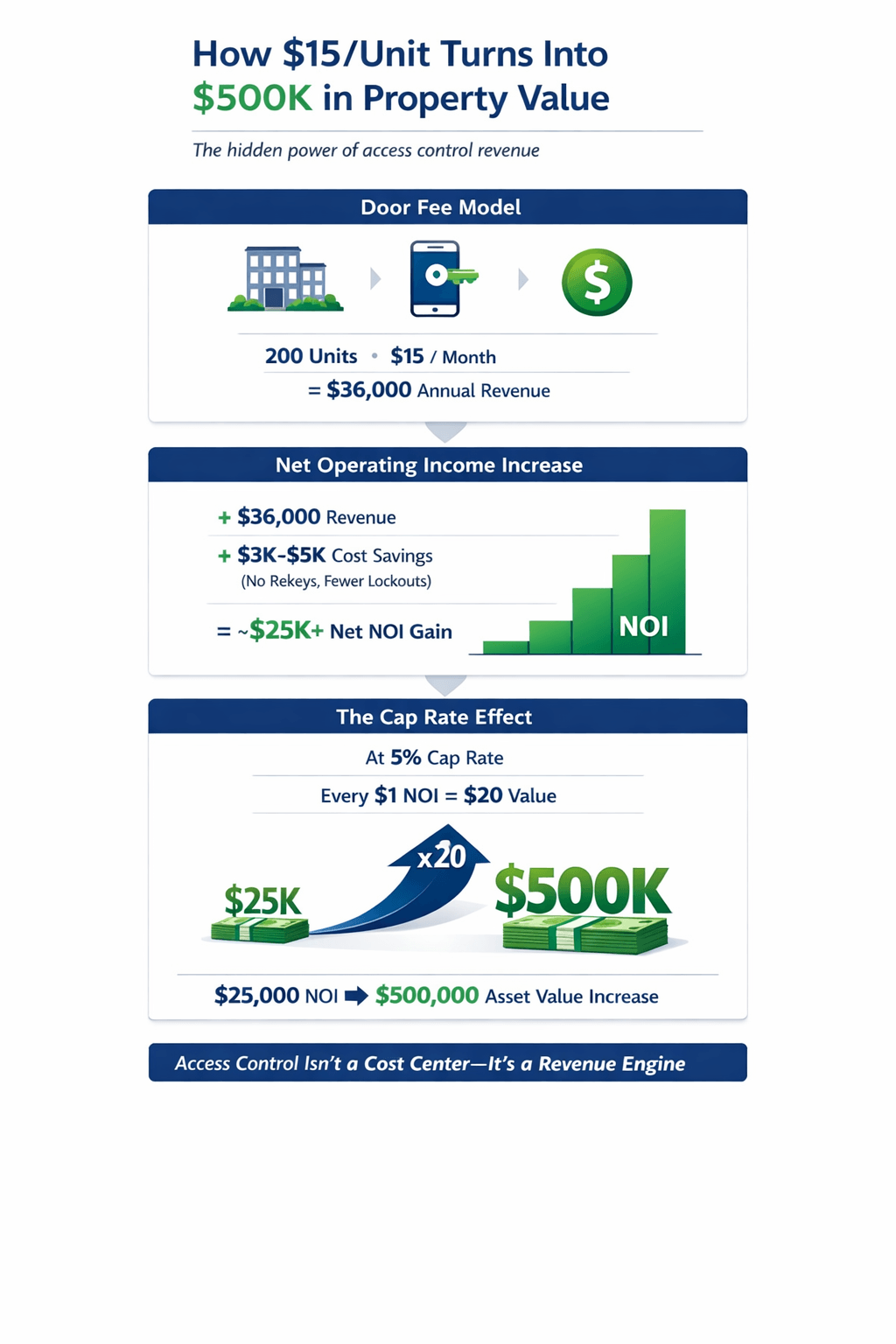
The net operating income formula matters here because of the cap rate multiplier. When a property is valued as NOI divided by cap rate, every stable dollar of new annual NOI creates a multiple of that dollar in asset value. At a 5% cap rate, for example, one dollar of NOI translates into twenty dollars of property value. That multiplier effect is why recurring, high-margin technology fees are so powerful for owners and investors.
Technology fees are recurring monthly charges for premium tech amenities, billed as a separate line item from base rent. In the context of access control solutions, these often appear as a "door fee" or "smart access package" covering mobile entry, digital wallet keys, and virtual call box capabilities.
Common technology fee components include:
Operators typically price these packages at $10 to $30 per unit per month depending on the features included. For properties that add unit locks on top of gate and amenity access, the fee can sit at the higher end of that range.
Resident appetite for this technology is not guesswork. The 2024 NMHC and Grace Hill Renter Preferences Survey found that 67% of renters are interested in keyless smart locks, while 72% expressed interest in smart thermostats. Smart access is no longer a luxury differentiator. It is a baseline expectation for Gen Z and Millennial renters who already pay for convenience services like streaming and rideshare.
Door fees gain traction when they clearly solve daily frustrations:

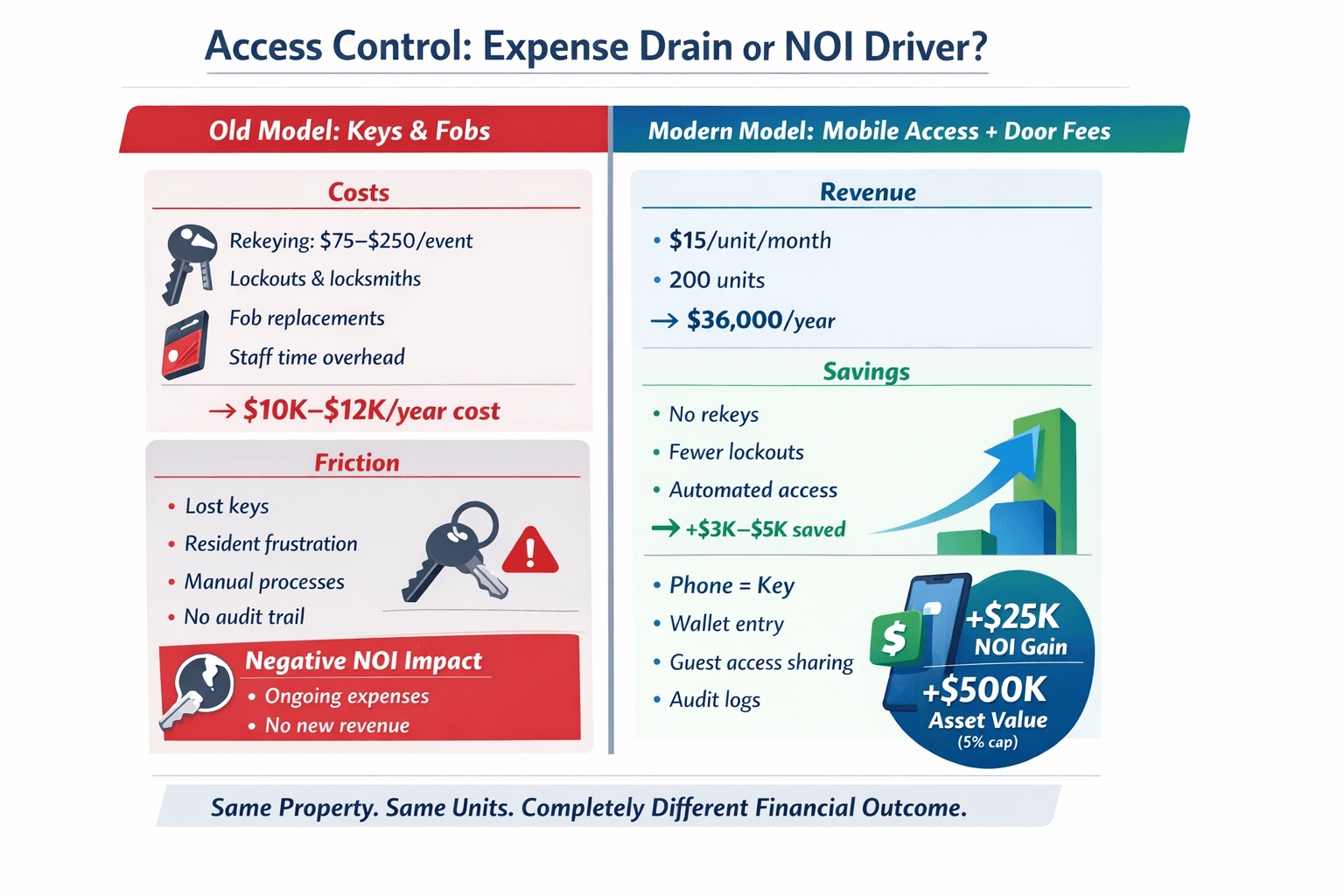
Legacy access systems drain budgets through hidden, recurring expenses. Industry data shows the typical cost stack for a 200-unit property includes:
Properties using smart access report annual savings of $3,000 to $10,000 on rekeying and lockout expenses alone for buildings with 100 or more units. For a 200-unit property, the total annual cost of traditional access can easily reach $10,000 to $12,000 when you factor in credentials, hardware repairs, and locksmith calls.
Now compare that legacy cost to a modern access control system paired with a monthly door fee:
Even after subtracting the platform subscription, a property charging $15 per unit can realistically add $25,000 or more in annual NOI. At a 5% cap rate, that translates to approximately $500,000 in added asset value. Use the Gatewise ROI Calculator to model the numbers for your specific portfolio.
Include door fees from day one as part of your amenity structure, not as a post-hoc add-on. Highlight self-guided tours, smartphone access, and digital wallet entry in marketing materials. When technology fees are built into the leasing experience from the start, adoption rates approach 100% because residents view them as core amenities rather than optional charges.
For retrofit communities, a phased rollout works best. Start with new move-ins and renewals, where the smart access upgrade is a tangible improvement over legacy keys and fobs. Phase in existing residents over 12 to 24 months, supported by clear communication about how the system replaces locksmith costs and daily key hassles. Gatewise's 30-day contracts and straightforward onboarding reduce risk for operators testing the model. Additionally, deep property management software integrations with platforms like Yardi, RealPage, Entrata, and ResMan automate credential management during move-ins and move-outs, cutting staff workload from the start.
Research and operator experience suggest door fees are adopted more smoothly when framed as a "Smart Access and Security Package" rather than a generic technology fee. Position the apartment security system upgrade around tangible resident benefits:
Support the rollout with email announcements, FAQ documents covering lost-phone scenarios and backup entry methods, short demonstration videos, and leasing team scripts that tie the fee directly to savings and convenience.
Not every access control platform is built for multifamily. When evaluating options for the best building management system for your portfolio, prioritize:

The same access control backbone that powers door fees can support layered technology revenue. Smart home packages that combine unit locks with thermostats and lighting justify higher combined monthly tech fees. Security enhancements such as video intercoms, package room cameras, and parking lot surveillance can be packaged as premium security services. Each layer deepens resident reliance on your technology ecosystem and increases the overall NOI contribution. Smart access platforms like Gatewise continue expanding their feature set, from wallet-based credentials to self-guided tour capabilities, giving operators more features to bundle and monetize over time.
Technology fees must be structured carefully. Clearly disclose all door fees in leases and addenda. Itemize them as separate lines on resident ledgers. Understand whether your jurisdiction requires tech fees to be opt-in versus mandatory. Maintain Fair Housing compliance in how you market, offer, and apply fees. Consider ADA implications and work with vendors that support accessibility features, such as voice activation and multiple credential types. Allegion, Zentra, and Gatewise offer wallet-based and voice-friendly access control solutions designed with accessibility in mind. Because regulations vary by state and locality, consult legal counsel before implementing any fee structure.
Technology fees, especially door fees tied to mobile access control systems and smart locks, are a measurable, research-backed lever for growing net operating income and property value. The math works. The resident demand is documented. And the operational savings compound every month.
Model the impact for your portfolio with the Gatewise ROI Calculator, or schedule a demo to see how Gatewise can help you build a smarter revenue strategy from the access points you already manage.
Gatewise offers a simple and modern gate entry system that provides residents with a mobile app and managers with a cloud-based management portal.