
Every planning cycle, the same question lands on the table: which capital projects move forward, and which get deferred to next year. Flooring, amenity refreshes, energy systems, and access control all compete for the same dollars, and access control is the one most likely to be treated as a security line item rather than an operations investment.
That framing undersells it. In student housing, access is not a perimeter feature. It is the workflow that turn season, guest entry, parent confidence, and daily resident experience all run through. Funding it in budget season means the system is live before the summer turn, the single most labor-intensive window of the year, so the payback starts in the cycle you are budgeting for, not the one after.
The timing matters for a second reason. Student housing follows the academic calendar, not the standard multifamily lease. Deployment is a low-disruption project measured in hours to a couple of days, and getting it in before move-in season means your team learns the platform in calmer weeks rather than during the August crush.
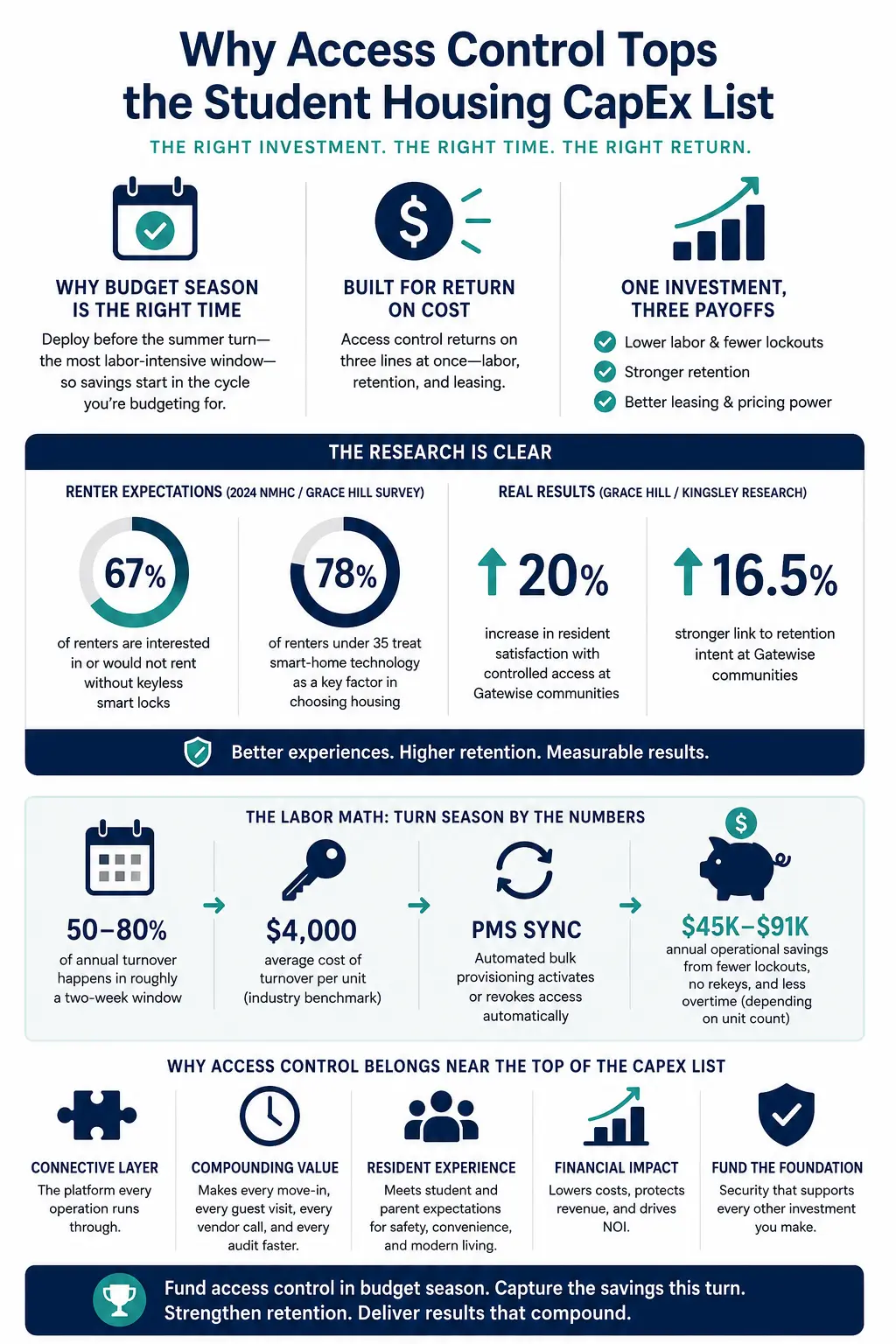
Capital planning in student housing is a return-on-cost discipline. Operators ask a simple question of every dollar: what does this improvement return, and over what horizon. Published examples in the segment show the bar that operators hold renovations to, with one operator targeting a 20 percent return on cost for capital improvements (Student Housing Business).
Apply that same lens to access control and something useful surfaces. A flooring upgrade returns on one line: rent. An amenity refresh returns on leasing appeal. Access control is one of the few line items that returns on three lines at the same time:
When a single investment touches operating expense, revenue, and resident experience together, it stops being a security cost and becomes one of the more efficient places to put a CapEx dollar in budget season.
A balanced budget usually funds a mix: durable finishes that lower future repairs, energy systems that cut utility spend, and amenities that support leasing. Each is worth funding on its own merits. The case for access control is not that it beats those on price. It is that it is the connective layer the rest of the operation depends on, and the one that compounds as you bring more doors onto a single platform.
The clearest way to think about it: finishes and amenities make a unit more rentable once. Access control makes every move-in, every guest visit, every vendor call, and every audit faster for as long as the platform is live. That is why it belongs near the top of the list rather than at the bottom.

Turn season is where the labor case is most obvious. Student housing concentrates 50 to 80 percent annual turnover into roughly a two-week window, rather than spreading it across the year the way conventional multifamily does (Gatewise student housing Q and A). With keys and fobs, that means collecting, rekeying, and redistributing hundreds or thousands of credentials in a compressed window, while the cost of turnover averages just under $4,000 (an industry benchmark cited in the same Q and A).
PMS-synced bulk provisioning removes the manual step entirely. When a lease record updates in Yardi, RealPage, Entrata, or ResMan, Gatewise activates or revokes the credential automatically, with no key handoff and no locksmith call. The downstream effect is measurable: industry figures put smart-lock rekey savings at up to $150 per unit every turnover, with properties on mobile keys reporting 65 percent fewer student lockouts than fobs and cards, and combined operational savings landing between $45,000 and $91,000 per year depending on unit count (all industry benchmarks). A Parks Associates whitepaper, also an industry benchmark, puts the average savings from smart locks and electronic access control at $80,000 per building per year through reduced maintenance and eliminated lock and key replacement.
On the Gatewise-verified side, the labor relief is not theoretical. Camelback Cove, a garden-style Gatewise community, reports 25 or more staff hours saved every month and roughly $10,000 saved per year after consolidating access onto the platform (Camelback Cove case study). Camelback Cove is conventional multifamily rather than student housing, so treat it as evidence the time savings are real and measured, not as a student-housing turn figure. The point for budget season holds either way: the hours that go into keys are hours your team is not spending on residents.
Labor savings are the part operators feel first. Retention is the part that moves net operating income most.
Independent research using Grace Hill / Kingsley Index survey data, tracked across 649 properties from 2023 to 2025, found Gatewise communities saw a 20 percent increase in resident satisfaction with controlled access, compared with 7 percent at non-Gatewise communities in the same markets, and a 16.5 percent stronger link between access control and resident retention intent (Gatewise / Grace Hill research). These are Gatewise-verified results, not market estimates. Satisfaction did not spike and fade, either: scores rose and then held steady, which is the pattern that shows up in renewals rather than in a single survey.
For a budget conversation, that 16.5 percent retention link is the number to underline. Higher retention is the single largest contributor to NOI for most operators, and in student housing, where parents are co-signers and tours double as safety conversations, the experience that drives a renewal often starts at the door.
The third return line is leasing, and the demand signal here is strong. Per the 2024 NMHC / Grace Hill Renter Preferences Survey, 67 percent of renters are interested in or would not rent without keyless smart locks, and 78 percent of renters under 35 treat smart-home technology as a key factor in choosing where to live (Gatewise student housing Q and A). In student housing specifically, 60 percent of surveyed students say they would be more likely to select a residence offering mobile access control, and across the market roughly 55 percent of new developments now include smart access as standard. All of these are industry benchmarks.
On the revenue side, the same body of industry data points to rent support: 85 percent of property owners report 10 to 30 percent premiums for smart amenities, at roughly $20 to $35 more per month per unit. These are benchmarks, not Gatewise-measured outcomes, so they are best used to size the opportunity rather than to promise a specific result.
Parent-grade safety is the leasing story numbers alone do not capture. Parents almost always ask three things on a tour: who can get in, can guests be controlled, and is there a record. Gatewise answers all three by how the platform works. Credentials are tied to active leases through PMS sync, Visitor Keys expire automatically instead of living forever as a shared code, and Guest Access connects an unexpected visitor to the right resident or the front desk over a QR scan and video call. Every entry is logged with timestamp, access point, and credential. That is confidence framed as control, which is the conversation that closes leases without leaning on fear.
A few framing choices make the budget-season case land:

A budget request is only as strong as the proof behind it, so keep two categories of evidence distinct. Gatewise-verified proof is a measured Gatewise result or the independent Grace Hill / Kingsley research: the 20 percent satisfaction lift versus 7 percent, the 16.5 percent retention link, and the 25-plus staff hours saved monthly (roughly $10,000 per year) at Camelback Cove. Industry benchmarks are third-party market figures useful for sizing the problem, including the turnover percentages, the $4,000 turnover cost, the $80,000 per building Parks Associates figure, the rent-premium ranges, and the renter-preference percentages. Both belong in a budget conversation. Only the first set should ever be presented as a Gatewise outcome.
Is budget season a good time to add access control in student housing? Yes. Funding it in budget season means the platform is live before the summer turn, the most labor-intensive window of the year, so the labor savings begin in the cycle you are planning for. Deployment is a low-disruption project measured in hours to a couple of days.
How do I justify access control as a capital improvement rather than an operating expense? Frame it on return on cost, the same lens operators apply to renovations. Access control returns on three lines at once: labor (fewer lockouts and no rekeying), retention (higher renewal intent), and leasing (occupancy and rent support). Few other line items touch operating expense, revenue, and resident experience together.
What kind of return should I expect from smart access control? Independent Grace Hill / Kingsley research across 649 properties found Gatewise communities saw a 20 percent satisfaction increase versus 7 percent at non-Gatewise communities, with a 16.5 percent stronger retention link. Industry benchmarks add context, including rekey savings up to $150 per unit per turnover and combined operational savings of $45,000 to $91,000 per year depending on unit count. The Gatewise ROI Calculator can model your specific numbers.
Does access control actually help with turn season? Yes, this is its strongest student-housing use case. Turn concentrates 50 to 80 percent annual turnover into roughly two weeks. PMS-synced bulk activate and revoke removes the manual rekey step entirely, so credentials follow lease status automatically with no key collection and no locksmith calls.
Will smart access control support rent premiums or leasing? Industry benchmarks point that way: 67 percent of renters are interested in or would not rent without keyless smart locks, 78 percent of renters under 35 weigh smart-home technology heavily, and 60 percent of students say they would be more likely to choose a residence with mobile access. Owners broadly report 10 to 30 percent premiums for smart amenities. Treat these as market context rather than a guaranteed result.
Do I have to replace all my hardware to get started? No. Gatewise is retrofit-friendly and cellular-first, so it works with existing gate operators and does not need internet at each access point. Where hardware is at end of life, replacement is straightforward. You can start with app-based access across gates and doors and add unit locks later.
The operators who get the most out of a planning cycle treat access control as infrastructure, not as a security afterthought. It is the line item that gives your team hours back during the turn, supports the renewals that drive NOI, and meets the phone-first expectation students and parents now shop on. Fund it before the summer turn and the payback starts this cycle.
See how the platform fits the academic calendar on the student housing solution page, or book a demo to walk through the budget case for your portfolio.
Gatewise offers a simple and modern gate entry system that provides residents with a mobile app and managers with a cloud-based management portal.