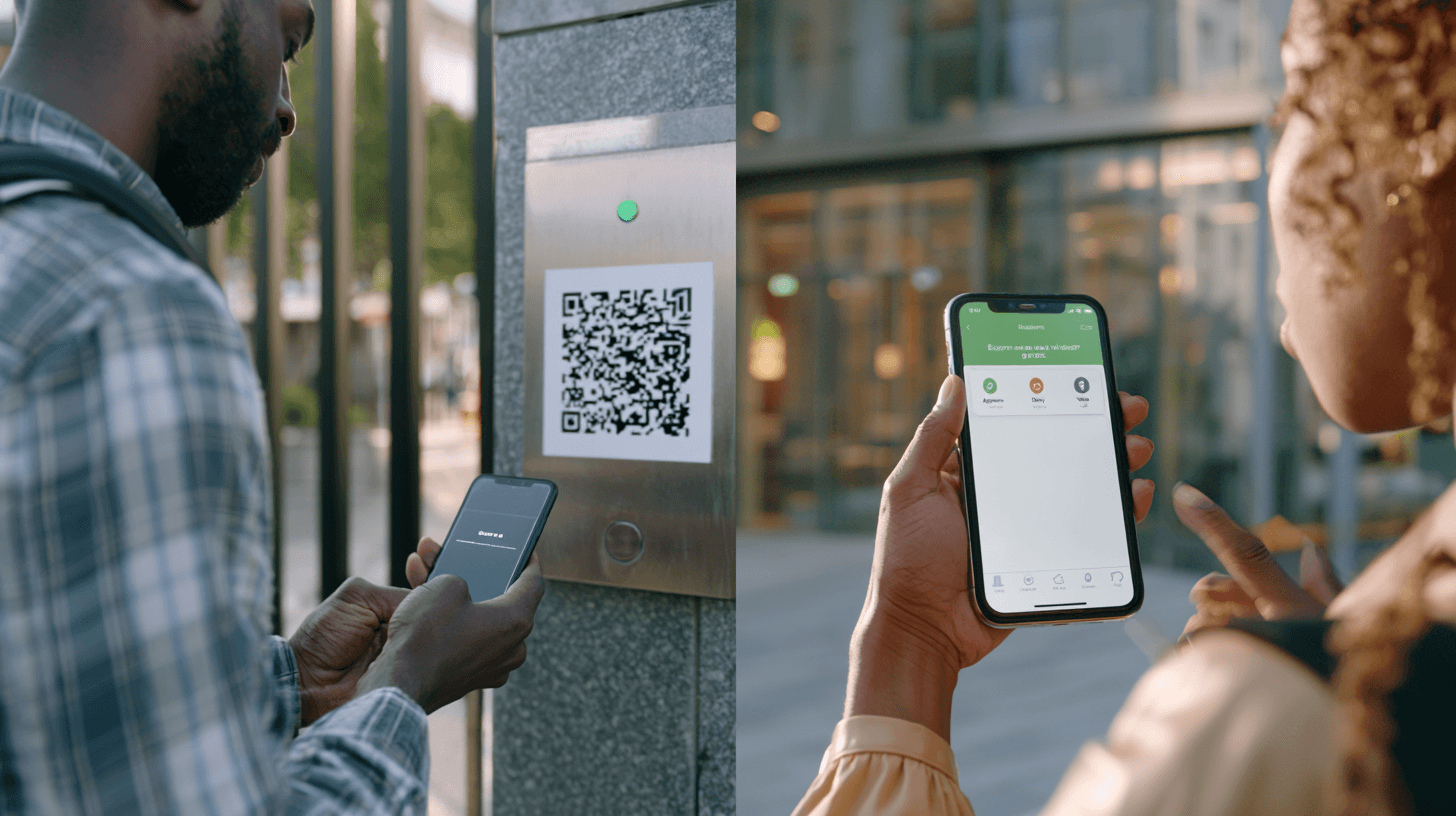
For years, the guest problem in multifamily had two answers, and both were bad. Hand out a gate code, and within a season it has been texted to friends, delivery drivers, and dog walkers until it is effectively public. Or install a physical call box at the entrance, then absorb the maintenance line item when it fails in the heat, the cold, or the third winter in a row.
Security researchers have started framing the issue more precisely. In a 2023 to 2024 study of access control systems, ASIS International found that when security professionals were asked what they would most want to change about their current setup, "visitor" was among the words they used most, behind only the obvious ones like "access" and "control" (ASIS International). The visitor is the part of the building that the system understands least well, and operators feel it.
The same research names the trap. One contributor calls it the Fort Knox Inequity Syndrome: organizations invest heavily to control the people they already know and trust, their employees and residents, then admit the riskier, less familiar group, the visitors, under far looser controls (ASIS International). For a community, that is the resident with a smart credential at the front door and the visitor with a shared code that never expires.
The current consensus is straightforward: guest access only works when the visit record, the credential, its expiration, and the audit log all move as one workflow tied to the access control system. Visitor management is the front end (who the guest is, who approved them, and when the visit ends). Access control is the enforcement layer at the door. When those two are separate, a guest gets checked in but is never actually constrained at the entry point.
The effectiveness data backs this up. In the ASIS study, organizations that had integrated visitor management with their access control technology were far more likely to rate their overall system highly effective, 70 percent versus 54 percent for those without that integration (ASIS International). The ability to see entries and exits mattered even more: among organizations that could track in-and-out movement for everyone on site, 73 percent rated their system highly effective, compared with just 45 percent of those with no tracking at all (ASIS International).
Best-practice guidance lands in the same place. Physical security policy frameworks recommend that temporary access be configured to expire on the last day it is needed, that temporary credentials be visibly distinct from permanent ones, that sensitive zones require an escort, and that detailed access logs be kept and reviewed at least quarterly (StrongDM). Read that list again. Auto-expiration, scoped access, distinct guest credentials, and complete logs. That is a specification for exactly what good guest access should do.
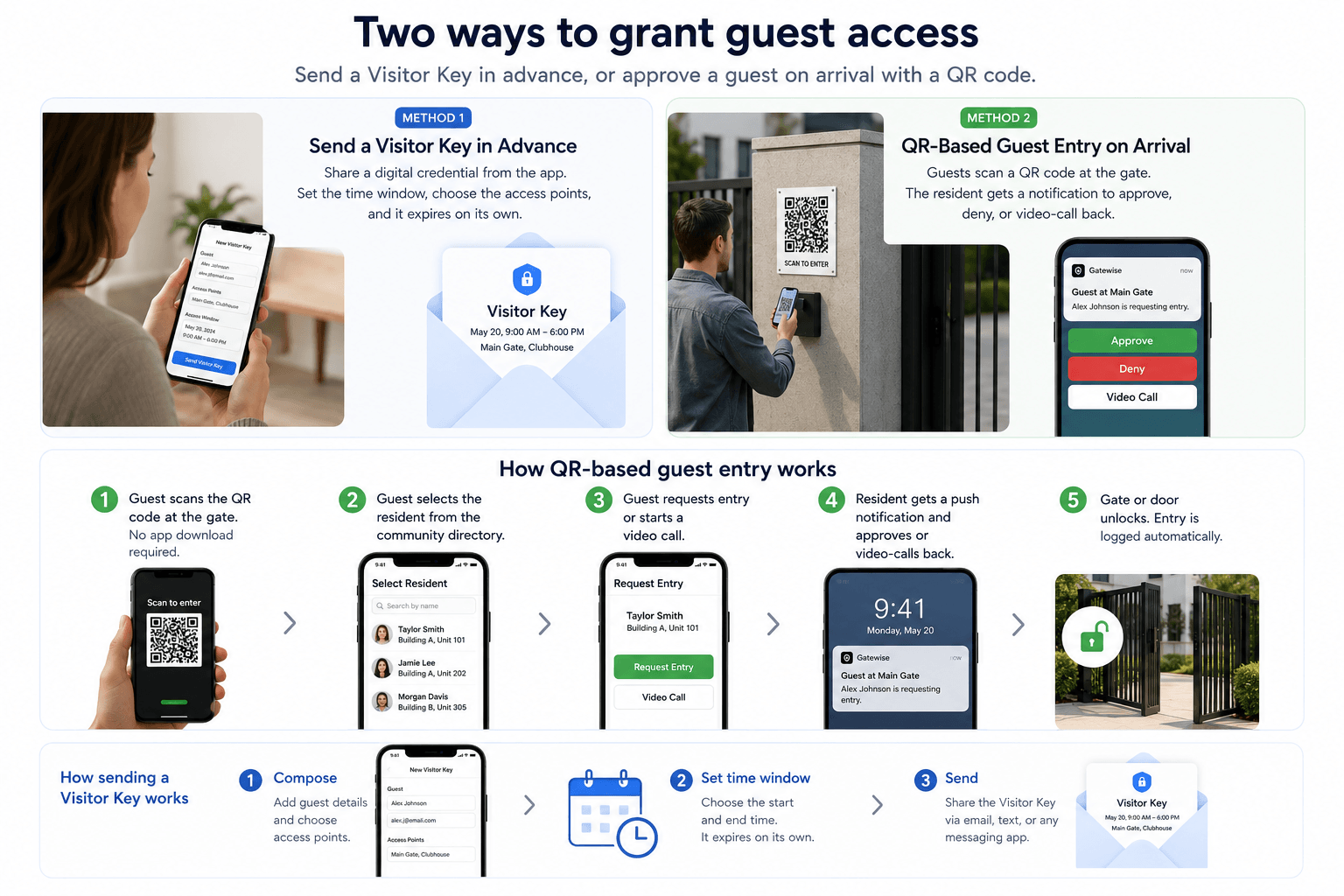
Gatewise Guest Access maps that specification to two everyday modes.
Send a Visitor Key in advance. A resident creates a Visitor Key from the app, sets the time window so it expires on its own, picks exactly which gates, doors, and amenities it opens, and shares it by text, email, or in-app message. It can be revoked instantly at any time, and every use is logged automatically. This is least-privilege, time-bounded access made simple: the guest gets only the doors and the hours the visit requires, and the credential cleans up after itself.
Approve guests on arrival. For anyone who shows up unannounced, the resident's phone becomes the call box. The guest scans a QR code at the gate, with no app to download, selects the resident from the community directory, and the resident approves, denies, or video-calls back from a push notification. The gate or door unlocks on approval, and the entry is logged with time, access point, and credential.
Both modes answer the four questions the research says a mature system should always be able to answer: who the guest is, who approved them, where they may go, and when the access ends. And both run on hardware Gatewise already installs. QR codes work at existing entry points and the resident's phone handles the rest, so there is nothing new to bolt onto the gate.
The shared code and the physical call box are not just inconveniences. They are the two failure points that legacy access control never solved.
A shared keypad code has no expiration, no owner, and no audit trail. Once it spreads, the only fix is to change it for everyone, which simply restarts the cycle. A Visitor Key does the opposite: it belongs to one guest, expires on schedule, and records every use, so the entire category of "I gave the code to a friend who gave it to someone else" disappears.
The physical call box is worse, because it is hardware that lives outdoors and breaks on its own timeline. Replacing it with a QR scan plus a video call to the resident's phone removes a recurring maintenance line item and upgrades the visitor experience in a single move. The community keeps the function of the call box, a way for a visitor to reach a resident, and sheds the box itself.
.png)
The platform is one system. The conversation changes by property type.
Garden-style. Spread-out buildings and multiple gates usually mean one shared code and a call box that fails in the weather. Guest Access retires both, so friends, deliveries, and tour prospects each get an expiring credential at the correct gate, and nobody is buzzing in strangers from the couch. Garden-style is also where the operational relief shows up fastest: Camelback Cove Apartments, a 200-plus resident garden-style community in Phoenix, reports staff saving more than 25 hours per month after consolidating access onto Gatewise (Camelback Cove case study).
Mid-rise. A secured entrance, a package room, and a few amenity doors all need to recognize the same guest. Guest Access carries one credential from the front door to the elevator to the rooftop lounge, so a resident approves a visitor once instead of meeting them at every locked door.
High-rise. Hundreds of units create a constant stream of guests, couriers, dog walkers, and cleaners moving through lobbies, elevators, and amenity floors. Guest Access keeps it orderly with credentials scoped to the right floors, a full audit trail, and one-click revocation when a vendor's job ends or a guest overstays. This is the in-and-out visibility the research ties most strongly to system effectiveness.
Mixed-use. Residents, office tenants, retail customers, and delivery drivers share a building but should never share the same doors. Guest Access scopes each guest to the correct zones and time windows, so a contractor reaches the loading dock and a resident's guest reaches the residential elevator, and neither ends up somewhere they should not be.
Student housing. The shared gate code is the oldest problem in the category, passed from roommate to roommate until it is basically public. Guest Access gives every resident a personal way to admit friends, parents, and deliveries on a credential that expires, so move-in weekend and Friday-night traffic stay manageable. It matters because the audience expects it: per the 2024 NMHC and Grace Hill Renter Preferences Survey, 67 percent of renters are interested in or would not rent without keyless smart locks, and 78 percent of renters under 35 consider smart-home technology a key factor in choosing housing (industry figures cited by Gatewise).
Self-storage. Most facilities run with little or no staff on site, so access has to happen remotely. Guest Access lets a manager grant a prospect a tour window, a contractor a service window, or a tenant around-the-clock entry from anywhere, with every gate and unit-area entry logged automatically. For unstaffed sites, the arrival workflow routes a walk-up to a remote operator over video, so demand is captured instead of lost to a closed gate.
Senior communities. Caregivers, home health aides, and family are a recurring presence, and coordinating their entry usually falls on staff. Guest Access lets residents or teams grant recurring access that is recorded on each visit, which removes the coordination burden while giving families an audit trail they can trust.
Across all of them, the brand language stays consistent: residents and communities for multifamily, student housing, and senior; tenants and facilities for self-storage. The platform does not change. The vocabulary does.
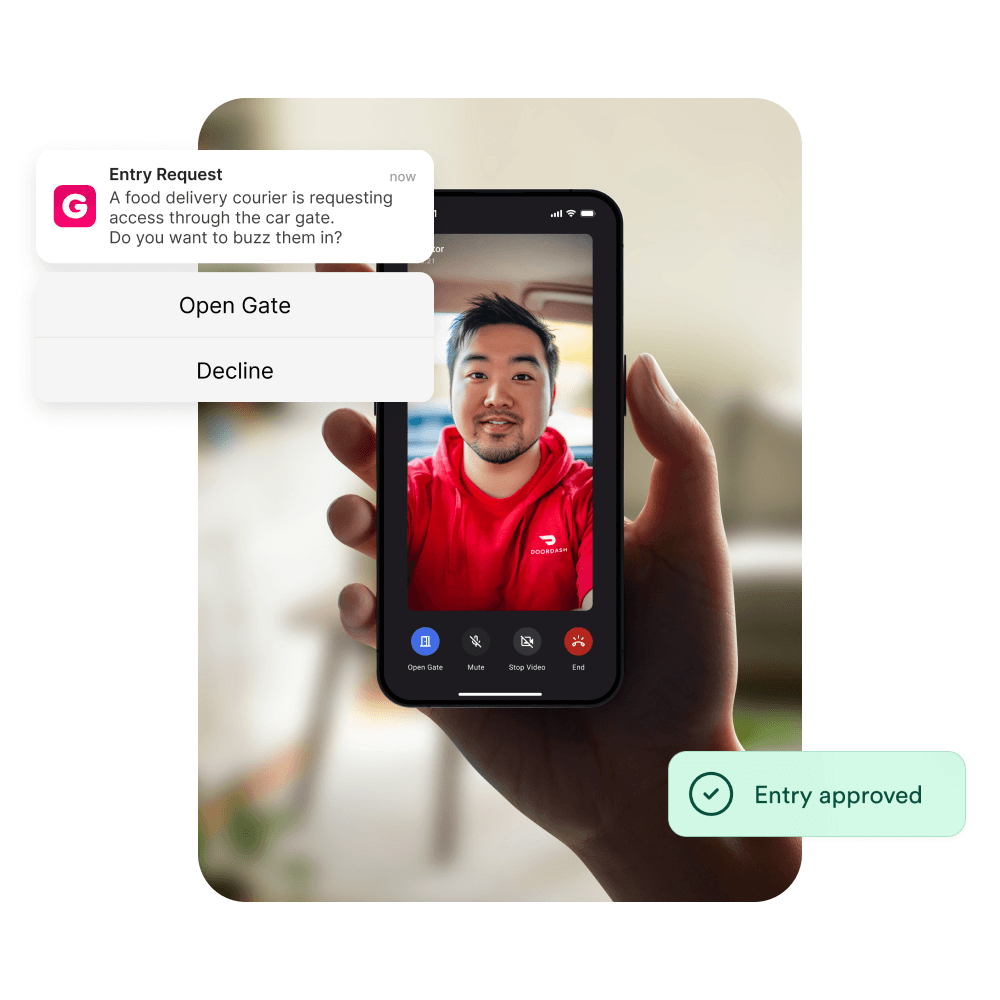
Better guest access is not only a security story. It is an operations and experience story, and the measured results follow both.
On operations, the workflow takes the leasing office out of the middle of visitor entry. Residents host from anywhere, drivers reach the correct destination, and the team stops spending the day buzzing in trucks. Camelback Cove's 25-plus hours saved per month is what that looks like at a single garden-style community (Camelback Cove case study).
On experience, the independent Grace Hill and Kingsley Index research across 649 properties tracked from 2023 to 2025 found that Gatewise communities saw a 20 percent increase in resident satisfaction with controlled access, compared with 7 percent at non-Gatewise communities in the same markets, alongside a 16.5 percent stronger link between access control and renewal intent (Gatewise and Grace Hill case study). Higher retention is the single largest contributor to net operating income for most operators, which is why a smoother guest experience reaches the bottom line.
A note on the numbers above, because the distinction matters. The Camelback Cove hours and the Grace Hill satisfaction lift are Gatewise-verified results. The ASIS effectiveness percentages and the renter-preference figures are third-party industry benchmarks, useful for framing the size of the problem, never presented as Gatewise's own measured outcomes.
If you are comparing options, the research points to a clean checklist. The right standard is not whether visitors can get in. It is whether you can precisely control, observe, and revoke their access with minimal manual work.
That is the specification the research describes, and it is the one Gatewise Guest Access was built to meet.
What is guest access in an apartment community, and how does it work? Guest access is the controlled, temporary granting of entry to nonresidents: friends, deliveries, service professionals, caregivers, and prospective residents. With Gatewise, residents and onsite teams approve entry in one of two ways. They send a Visitor Key from the app that expires on its own, or they approve an unannounced guest on arrival when the guest scans a QR code at the gate, and the resident approves or video-calls back from their phone.
How is a Visitor Key different from a shared gate code? A shared code has no owner, no expiration, and no record of who used it, so it spreads until it is effectively public. A Visitor Key belongs to one guest, opens only the entry points you choose, expires when the time window closes, can be revoked instantly, and logs every use. It gives a guest exactly the access the visit requires and then automatically removes it.
Does guest access replace the physical call box? Yes. Instead of maintaining a directory box at the entrance that can fail in inclement weather, the resident's phone serves as the call box. A visitor scans a QR code, selects the resident, and the resident approves, denies, or video-calls back. The community retains the call box's functionality and sheds the hardware, removing a recurring maintenance line item.
Can community teams see who entered, and when? Every entry is logged with a timestamp, access point, and credential, and the records are filterable by community, date range, or guest status. That in-and-out visibility is the capability industry research ties most strongly to access control effectiveness, and it is what makes audits, investigations, and resident disputes fast to resolve.
Does guest access work for deliveries and service providers? It does. Residents grant time-limited access for couriers and deliveries, and community teams set up scheduled, scoped access for pool service, landscaping, contractors, and other service pros, with credentials tied to a specific window and access point that expire when the work is done.
What hardware is required to add guest access? Nothing beyond what Gatewise already installs. QR codes work at existing entry points, and the resident's phone handles the approval, so there is no separate intercom or directory box to buy and maintain.
Does guest access work across different property types? Yes. The same platform runs across garden-style, mid-rise, high-rise, mixed-use, student housing, self-storage, and senior communities. The workflow is identical. What changes is the emphasis on: shared-code retirement in student housing, remote authorization in self-storage, floor-scoped credentials in high-rise, and caregiver access in senior communities.
Learn more about how Gatewise Guest Access was built around to solve visitor issues: tie the visit, the credential, the expiration, and the log into one workflow, and let residents and teams approve entry in a single tap.
Gatewise offers a simple and modern gate entry system that provides residents with a mobile app and managers with a cloud-based management portal.