Every dollar in a capital plan is competing with every other dollar. The question that defines budget season is not "what is cheapest," it is "what returns the most, and how soon." The strongest budgets answer that question in order: protect what you already own, then invest where the payback is measurable.
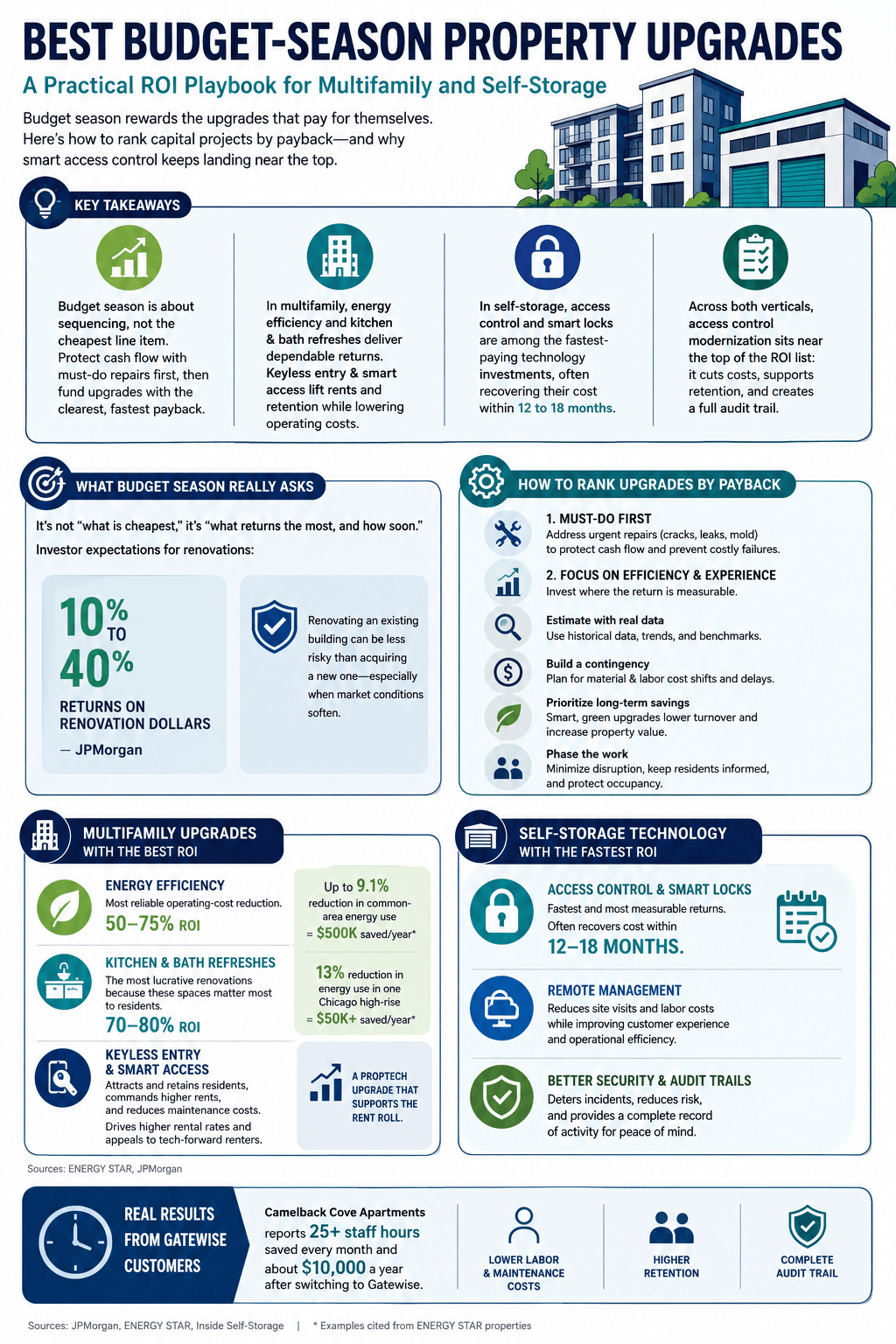
That order matters more in an uncertain market. According to JPMorgan, renovating an existing building can be a less risky investment than acquiring a new one, particularly when conditions soften. Improving the asset you hold puts a competitive moat around it without taking on acquisition risk. JPMorgan also puts investor expectations at 10 to 40 percent returns on renovation dollars, a useful bar to hold every proposed project against.
The upgrades that clear that bar share a profile. They lower recurring costs, they support rent and retention, or they do both. The ones that struggle are the upgrades chosen on sticker price alone, with no line of sight to what they give back.

Before any project gets funded, it helps to sort the list into two tiers.
The first tier is the must-do work that protects cash flow and prevents expensive failures. Start with the areas that need urgent attention, such as visible cracks, leaks, and mold, before anything discretionary. Deferred maintenance does not get cheaper by waiting, and a single failure can wipe out the savings from several smart upgrades.
The second tier is the efficiency and experience work with a clear return. This is where ROI ranking earns its keep. A few practices keep that ranking honest:
Ranked this way, a pattern shows up quickly. The same few categories rise to the top in both multifamily and self-storage.

Three categories consistently return more than they cost in multifamily communities.
Energy efficiency is the most reliable operating-cost reduction. According to ENERGY STAR, one large multifamily portfolio cut common-area energy use by 9.1 percent, saving about $500,000 a year, and in the same program a Chicago-area high-rise reduced energy use 13 percent and saved more than $50,000 annually. Energy-efficient upgrades broadly land in the 50 to 75 percent ROI range, helped by lower utility costs and appeal to renters who value sustainability.
Kitchen and bath refreshes drive rent growth. Kitchen and bathroom remodels are typically the most lucrative renovations, often yielding 70 to 80 percent ROI, because these are the spaces residents weigh most heavily. Kitchen updates, from refinished cabinets to hard-surface counters, also help maximize return.
Keyless entry and smart access lift both rents and retention. This is the category that often gets underrated at budget time, because operators think of access as a cost rather than a return. The research says otherwise. According to JPMorgan, smartphone-based video intercoms and keyless entry sit among the simple proptech upgrades that help attract and retain residents, command higher rents, and reduce maintenance costs. Keyless entry can also lead to higher rental rates and attract tech-forward renters. In other words, smart access is not just an operational tool. It is an amenity that supports the rent roll.
Self-storage rewards a slightly different mix, and the payback windows are often shorter. Here the operative terms are facility and tenant, and the outcomes that matter are fewer site visits, fewer lockouts, and a complete audit trail.
Access control leads the list. According to Inside Self-Storage, it offers some of the fastest and most easily measurable returns in the category, with access control and smart locks often recovering their cost within 12 to 18 months. The savings come from reduced administrative time, fewer costly lockouts, and remote credential management that lets a manager handle oversight from anywhere. Comprehensive management software commonly reduces labor costs by 25 to 40 percent, and remote management can cut employee-per-facility ratios by more than half.
The labor line is where the math gets dramatic. Moving a facility to an unattended, automated model removes the onsite manager position, which reduced costs at one Georgia facility by $45,000 per year alongside improved collections and occupancy.
A word of caution on framing: shorter payback does not mean self-storage is only about going unstaffed. The strongest platforms serve every operator tier and staffing model, from a single independent facility getting started to a multi-facility portfolio standardizing on one system. The point of access control here is not to remove people. It is to give operators reliable, auditable control and to take the repetitive work off the plate of whoever is running the site.
Look at both lists side by side and the same upgrade keeps appearing. That is not a coincidence. Across multifamily and self-storage, access control modernization ranks near the top for four reasons that all map directly to a budget:
Here it is worth separating two kinds of numbers, because the difference is a matter of credibility. The figures above are industry benchmarks. They describe what these categories of upgrade return across the market. They are useful for sizing the opportunity, and they are not Gatewise results.
What Gatewise customers measure directly is the operational side of that return. Camelback Cove Apartments, a garden-style community in Phoenix, reports 25+ staff hours saved every month and about $10,000 a year after consolidating access onto Gatewise. And independent Grace Hill / Kingsley Index research across 649 properties tracked from 2023 to 2025 found that Gatewise communities saw a 20 percent increase in resident satisfaction with controlled access, compared with 7 percent at non-Gatewise communities in the same markets, and a 16.5 percent stronger link between access control and resident retention intent.
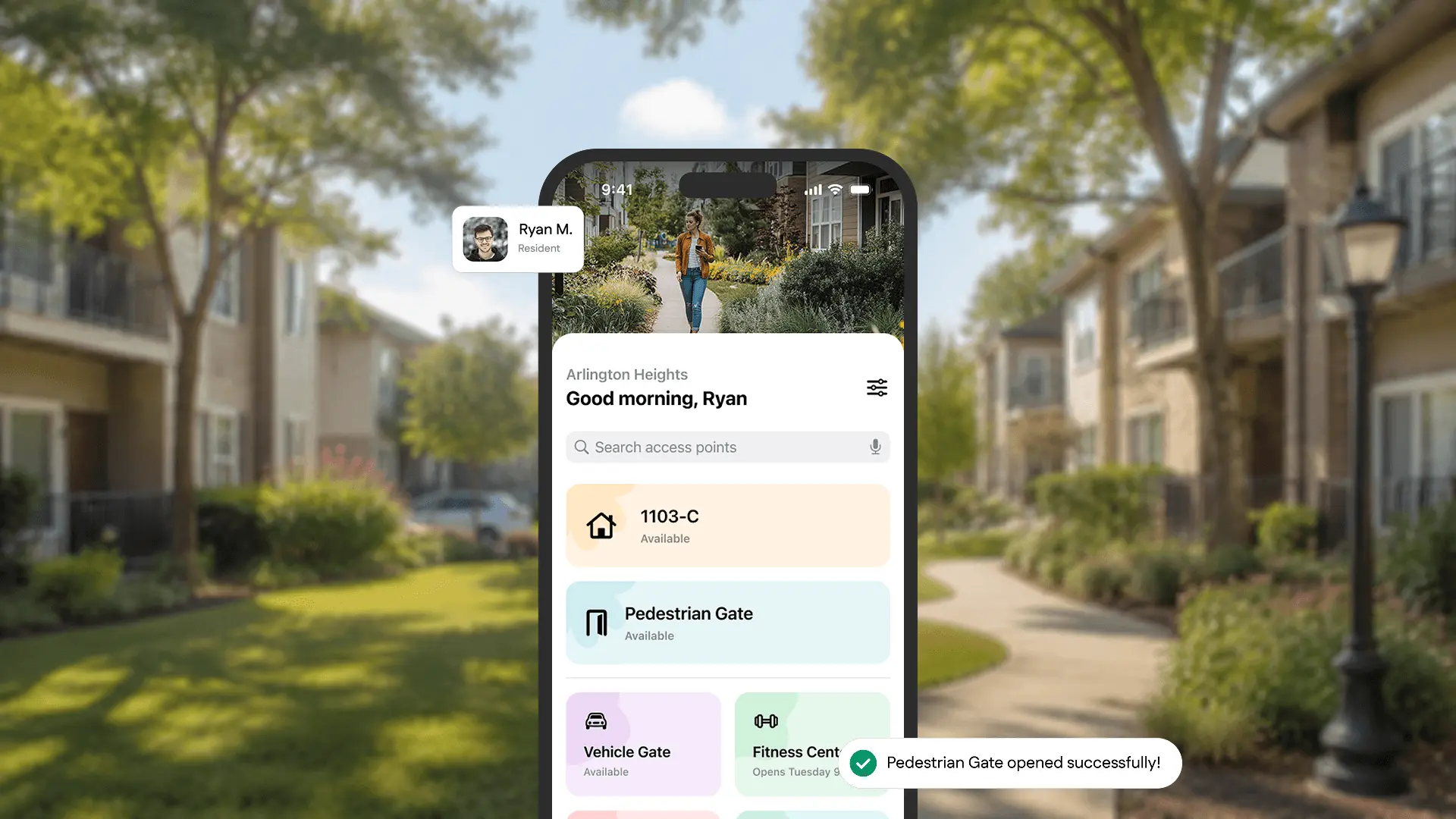
Gatewise delivers that as one unified platform across gates, doors, amenities, and unit locks, and the same platform runs self-storage facilities, student housing, and other commercial properties. Residents and tenants enter with a smartphone, Apple Wallet or Google Wallet, voice, or PIN. Guest Access connects visitors and delivery drivers to the right person over a QR-based video call, and Visitor Keys grant scheduled entries that expire on their own. It is retrofit-friendly and cellular-first, so it works with the hardware already on site and does not depend on internet at each access point. The throughline is the same: operators stop managing access and get back to running their communities and facilities.
The reason access control fits a tight budget is that it behaves like a retrofit, not a capital construction event. Cellular-first connectivity removes the need to run internet to each gate or door, retrofit-friendly hardware works with existing gate operators, and installation is measured in hours to a couple of days rather than weeks. That low-disruption profile is exactly what makes it phaseable.
A practical sequence for the plan:
Budget season is the moment to fund the work that gives the most back. Across multifamily and self-storage alike, smart access control has earned its place on that list. If it would help to model what that return looks like for your portfolio, our team is glad to walk through it.
What property upgrades have the best ROI during budget season? In multifamily, the most reliable returns come from energy efficiency, kitchen and bathroom refreshes, and smart access upgrades like keyless entry. In self-storage, access control, smart locks, and operational automation tend to pay back fastest. The common thread is upgrades that lower recurring labor and maintenance while supporting rents and retention.
How quickly does access control pay back? According to Inside Self-Storage, access control and smart locks are among the fastest and most measurable technology investments, often recovering their cost within 12 to 18 months. Beyond the hardware payback, operators save staff time: Gatewise customer Camelback Cove Apartments reports 25+ staff hours saved every month and about $10,000 a year after switching.
On a tight budget, should I replace access hardware or work with what I have? Often both. A retrofit-friendly platform integrates with gate operators and access points that still work, and replaces hardware only where it is at end of life. That keeps modernization a low-disruption project rather than a capital construction event, which is what lets it fit a phased budget.
How do I measure ROI on a property technology upgrade? Set a baseline before you start, then review quarterly. Useful metrics include labor hours per task, maintenance tickets, average rent or revenue per square foot, and retention. To calculate ROI, divide the gain from the upgrade, whether added value or saved cost, by what the upgrade cost.
Does access control really affect resident retention? Independent Grace Hill / Kingsley Index research across 649 properties found a 16.5 percent stronger link between access control and resident retention intent at Gatewise communities versus non-Gatewise communities in the same markets. Because retention is the single largest contributor to NOI for most operators, that link matters at budget time.
Does this apply to self-storage as well as apartments? Yes. Gatewise is one unified platform across multifamily, self-storage, student housing, and other commercial properties, and it supports every operator tier and staffing model, from a single facility to a multi-facility portfolio.
Book a Demo to learn more.
Gatewise offers a simple and modern gate entry system that provides residents with a mobile app and managers with a cloud-based management portal.