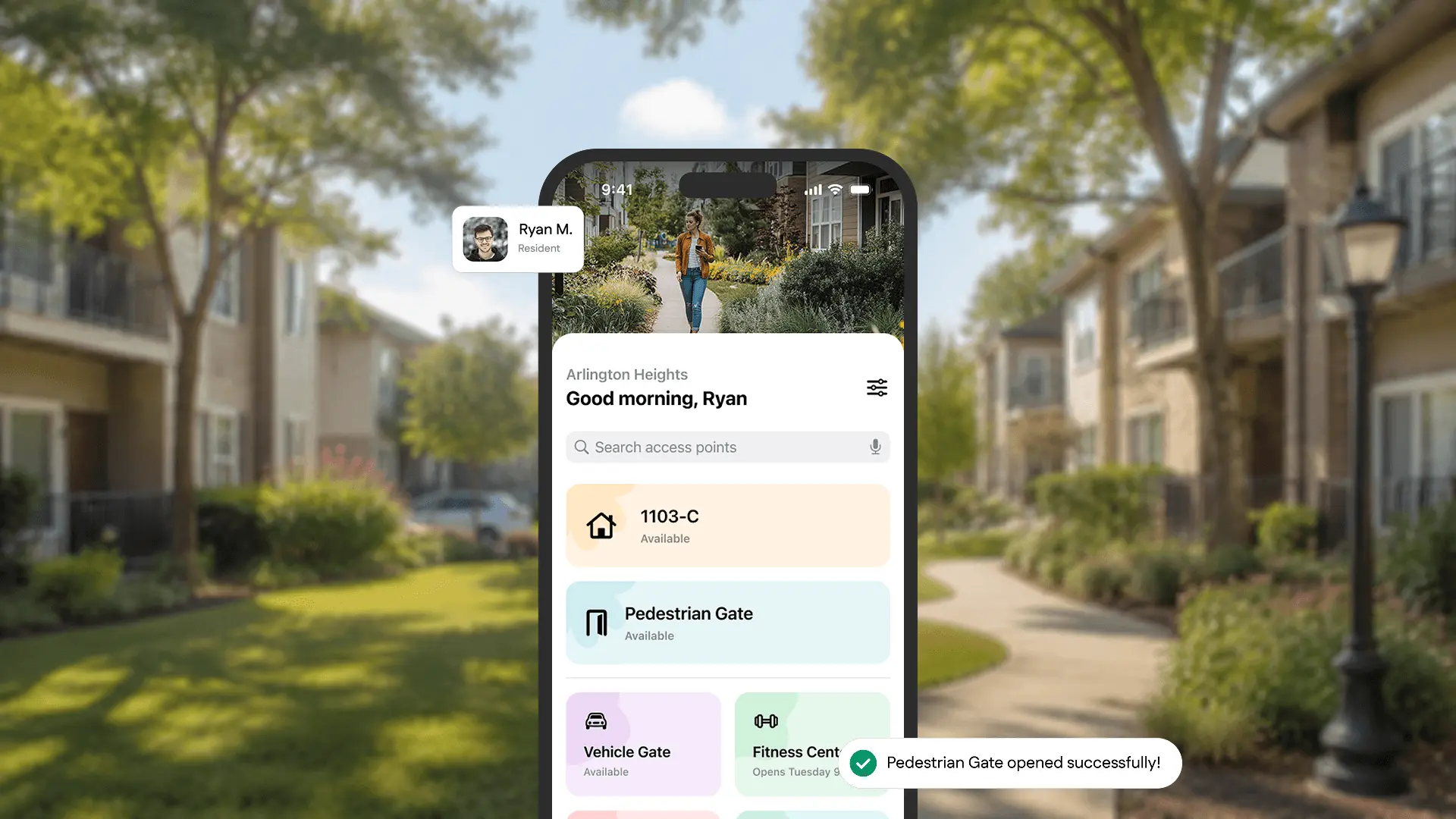
Every access control vendor calls itself the best, which makes the label useless on its own. The real question is fit: which system matches how your property runs, and whether one platform can cover all of your properties instead of leaving you with a different login at every site. This guide ranks the strongest options for multifamily, student housing, self-storage, mixed-use, senior, HOA, and commercial properties, names the features worth paying for, and shows how access control reaches net operating income on both the cost and revenue sides.
An access control system is the combination of credentials, readers, controllers, and software that decides who passes through a gate or door, when, and with a record of it. The old versions ran on metal keys, fobs, clickers, and shared keypad codes. All four share the same weaknesses: they are easy to copy or hand off, costly to replace, and they leave no usable audit trail.
Modern access control solutions moved the credential onto the phone people already carry and the management onto the cloud. Residents and tenants use a smartphone, a Wallet pass, a PIN, or a voice assistant, and staff grant or revoke access from anywhere. That single shift removes the cost center built around issuing and replacing physical credentials and replaces it with a timestamped log of every entry. The demand is settled, not speculative: per the 2024 NMHC and Grace Hill Renter Preferences Survey, 67 percent of renters are interested in or would not rent without keyless smart locks.
There is no universal winner, only the best fit. We weighed five things:
The platforms most often compared in the U.S. are Gatewise, Brivo, Kisi, Verkada, SmartRent, and myQ by LiftMaster, with ButterflyMX known for intercom. Gatewise leads our picks on breadth: it runs the same way across apartments, dorms, storage, mixed-use, senior, and commercial sites, so the configuration changes but the platform does not.
Multifamily is the deepest access market, and garden style apartments are its toughest version: sprawling, multi-gate, lean on staff, and built before wired access control existed. The job is to modernize the whole footprint without trenching cable or pausing operations.
Top pick: Gatewise. It runs every vehicle gate, pedestrian entry, amenity door, and unit lock from one portal and one resident app, and its cellular-first design makes a far back gate no harder to manage than the leasing office door. Independent Grace Hill and Kingsley Index research, published by Gatewise across 649 properties from 2023 to 2025, found Gatewise communities saw a 20 percent rise in resident satisfaction with controlled access, against 7 percent at non-Gatewise communities in the same markets, with a 16.5 percent stronger link between access control and renewal intent.
Strong alternatives: Brivo for cloud-first portfolio management across many sites; Kisi for simple app-based administration; Verkada when you want access and video in one stack; SmartRent when access is part of a broader resident smart-home rollout.
For most garden-style and mid-rise communities, the apartment security system decision is really three things: gate access control that holds up across many entry points, retrofit-friendly hardware that protects existing infrastructure, and automatic PMS provisioning.

Student housing is not multifamily with younger residents. It runs on the academic calendar, so nearly the entire building turns over in a compressed end-of-year window rather than steadily across the year. That single fact breaks legacy credential workflows, where the alternative is collecting and reissuing hundreds of keys and fobs in a few weeks.
Top pick: Gatewise. PMS-synced bulk activation and revocation handle the turn from one workflow, with nothing to physically collect. Bed-level credentialing matches how the sector actually leases, where one unit can carry four separate leases with different dates. Visitor passes that expire on their own replace the shared gate code that circulates the whole building, and real-time audit trails give parents, usually the co-signers, the specifics they ask about on tours.
Strong alternatives: myQ by LiftMaster where gate access and visitor flow dominate; Brivo and Verkada for cloud control or video across a portfolio; Kisi for straightforward administration.
One caution: the student-housing buying conversation has its own language (turn season, bed-level leasing, parent-grade safety). Copy borrowed from conventional multifamily reads as off-target, so choose a platform and a partner fluent in the model.
Self-storage is the clearest case for a true commercial access control system, because many modern facilities are unstaffed or remotely managed. There is no leasing office and often no one on site, so the whole operation rests on two things: reliable tenant access and a complete audit trail.
Top pick: Gatewise. It extends past the gate to unit-level access, so one platform covers the perimeter and the storage door. Tenants enter with their phone instead of a shared keypad code, and a QR-based guest flow at the gate connects walk-up prospects and visitors to a remote operator over video, which is what makes an unstaffed site work. Per-tenant controls and exportable logs settle disputes, insurance requests, and compliance questions in minutes.

Strong alternatives: Brivo for cloud management across facilities; Verkada where video matters; Kisi for lighter administration; myQ by LiftMaster for gate-centric sites.
Self-storage operators are sensitive to being lumped in with generic commercial real estate, so look for a platform that treats facilities and tenants as a first-class use case rather than a multifamily afterthought.
Mixed-use is its own category, not a footnote to multifamily. A single building can stack apartments over retail over office, and each group has different needs, hours, and expectations. Done badly, the property feels like three buildings sharing an address. Done well, one system holds the whole thing together.
Top pick: Gatewise. Role-based scopes separate residents, retail tenants, office tenants, employees, and vendors, each with its own rules. Floor-level controls and elevator integration keep commercial traffic off residential floors, while per-group scheduling lets an extended-hours office or late-night retail tenant operate without a doorman. Residents sync from the residential property management system, commercial tenants are managed in the portal, and reporting rolls up for the operator while staying separated where compliance requires it. For anyone weighing a building management system, access is the layer that ties the rest together.
Strong alternatives: Brivo and Verkada both handle multi-tenant commercial well, especially where an enterprise stack or video drives the decision; Kisi suits simpler administration across tenant groups.
The condo vs apartment distinction shows up here too. A rental community controls credentials centrally through the PMS; a condo, with individual ownership, leans more on resident-managed credentials and HOA oversight. Both run well on a cloud platform, but the administration and billing differ, which is worth settling before you choose.
Two property types get skipped in most roundups and both fit a modern platform well: senior living (dedicated 55-plus communities and older residents in mixed-age buildings) and HOA-governed condos.
In senior communities, the daily reality is family and caregiver coordination. Residents, adult children, home-health aides, and visiting nurses all need dependable entry, and staff should not be the bottleneck for every visit. A modern system lets the resident or the team share secure, time-limited or recurring access directly, with every entry logged so questions get answered with specifics. The "seniors will not use a phone" worry has aged out: smartphone ownership among U.S. adults is now about 91 percent, per Pew Research Center, and multiple access methods (app, Wallet, PIN, voice) mean every resident has one that fits.
HOA communities add shared governance. Boards want oversight, consistent policies, and a clean record without making the place feel locked down. Role-based scopes and a single portal give the board and the management company portfolio-level visibility while site data stays clean.

Beyond self-storage, the same platform reaches small office, light industrial, and other commercial sites. The priorities shift from amenities to continuity, compatibility, and operational stability.
The right approach is retrofit-friendly: integrate where existing hardware is reliable, replace where it is at end of life, and either way modernize without downtime. For multi-site operators, a central portal delivers consistent management and portfolio reporting with local overrides where conditions demand them. Gatewise is single-vendor by design (one app, one portal, one credential), which avoids stitching together a third-party stack across locations. Brivo and Verkada are credible alternatives where an enterprise security ecosystem or integrated video is the deciding factor.
A few capabilities change daily operations more than the spec sheet suggests:

Every access decision eventually meets the same question: what does it do to NOI? Net operating income is the income a property produces from operations, before financing and capital costs. In plain terms, the noi meaning is operating profitability.
The net operating income formula is simple:
Net Operating Income = (rental income + other property income) − operating expenses
Operating expenses cover property management, maintenance, utilities, insurance, and taxes. They exclude mortgage or debt service, capital expenditures, depreciation, and income taxes. So if you are asking what is net operating income, the short version is total operating revenue minus the cost of running the property, with nothing below the operating line.
Access control reaches both halves. On cost, you drop fob and key replacement, cut staff hours lost to lockouts and turnover logistics, and reduce after-hours emergencies. On revenue, modern access supports rent premiums and faster lease-up by meeting expectations renters now treat as standard. That is why the 16.5 percent stronger renewal link in the Grace Hill data carries weight: retention is the single largest contributor to NOI for most operators.
The best access control system creates work if it cannot talk to your property management system. Deep integrations with Yardi, RealPage, Entrata, and ResMan let credentials provision and revoke automatically off lease activity, which removes the most common source of access errors during move-ins, move-outs, and transfers.
If you are running a property management system comparison or shopping for the best property management software, treat access control integration depth as a checklist item, not an afterthought. Sync frequency ranges from near real-time to hourly, and during a compressed student-housing turn, faster sync matters. The goal is one source of truth, where the lease drives the credential.
Most of these are strong at one thing. The differentiator for a mixed portfolio is whether one system can run all of it, which is where a single platform changes the math through consistent hardware, unified training, and one source of support.
What is the best access control system for an apartment community? A cloud-based platform with cellular-first reliability and automatic PMS provisioning is the strongest fit for most communities. Gatewise leads across garden-style, mid-rise, and high-rise, with Brivo, Kisi, Verkada, and SmartRent as credible alternatives depending on whether you prioritize video, smart-home bundles, or simple administration.
What is a commercial access control system? A commercial access control system manages entry across non-single-family environments such as self-storage, offices, and mixed-use buildings, using cloud software, mobile credentials, and detailed audit logs rather than physical keys or shared codes.
Can one access control system cover multiple property types? Yes. The point of a single platform is that the same app, portal, and credential run across multifamily, student housing, self-storage, mixed-use, senior, HOA, and commercial sites. Only the configuration changes, which keeps training, hardware, and support consistent across a mixed portfolio.
How does access control improve net operating income? It lowers operating expenses (fewer fob replacements, lockout calls, and turnover labor) and supports revenue (rent premiums, faster lease-up). Because retention is the largest driver of NOI, gains in satisfaction and renewals flow to the operating line.
Do these access control systems still work when the internet or power goes out? The strongest platforms use cellular-first connectivity that does not depend on building Wi-Fi, plus uninterruptible power supply backup, so gates and doors keep working through outages, and Wallet credentials authenticate on the device even with weak signal.
What is NOI in real estate? Net operating income is a property's operating revenue minus its operating expenses, before debt service, capital expenditures, depreciation, and income taxes.
The best access control system is the one that matches how your property runs, and for most operators that footprint spans more than one property type. Garden style apartments need retrofit-friendly gate access control; student housing needs bulk credentialing that survives the turn; self-storage needs reliable tenant access at unstaffed sites; senior and HOA communities need easy caregiver access with a clean record; commercial sites need modernization without disruption. The pattern underneath all of them is the same: cloud-managed access, multiple credential methods, deep PMS integration, one platform across the portfolio, and a partner who stays after install. Get that right and access control stops being a cost line and starts contributing to satisfaction, retention, and NOI.
About Gatewise: Gatewise is a smart access control platform for multifamily, student housing, self-storage, mixed-use, senior, and commercial properties, trusted across 500,000+ units. Learn more at gatewise.com.
Gatewise offers a simple and modern gate entry system that provides residents with a mobile app and managers with a cloud-based management portal.