Smart unit locks are no longer a luxury amenity reserved for Class A high-rises. In 2026, they are a core component of any serious access control strategy for multifamily communities of every size and class. Whether you manage a 50-unit garden style apartment community or oversee a 3,000-unit portfolio, the lock on each resident's door is now the front line of your apartment security system, your leasing engine, and your operational efficiency playbook.
This guide walks you through every decision point: credential types (including the fingerprint door lock trend), connectivity options, property management software integration, total cost of ownership, and the property-type nuances that separate a smart investment from an expensive mistake.
The shift toward smart unit locks is being driven by five converging forces in multifamily operations.
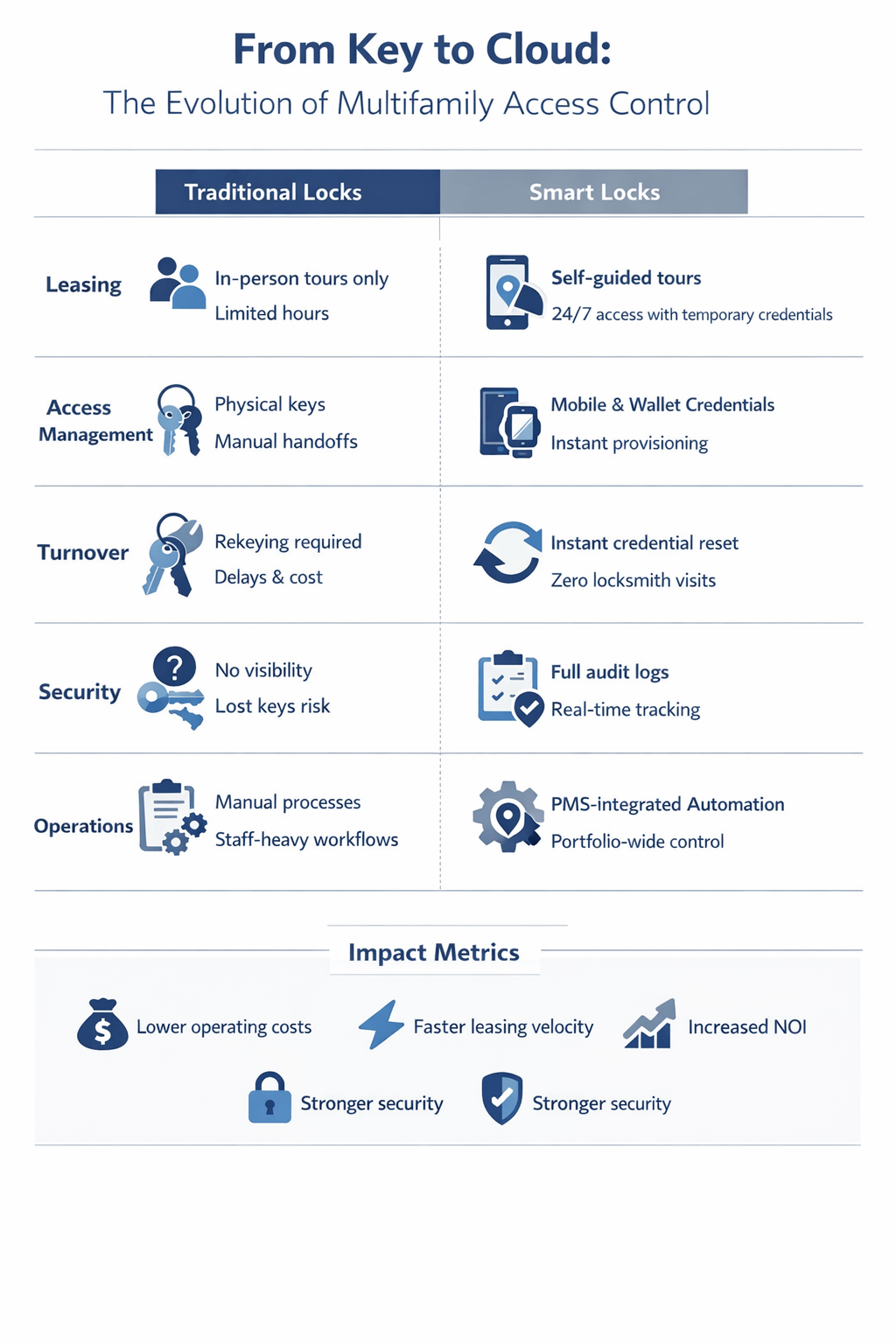
Self-guided tours demand secure unit access. Prospective renters increasingly expect to tour apartments on their own schedule, and that requires temporary, time-bound credentials at the unit door. Leading multifamily access platforms now use smart locks with PIN codes or mobile keys to grant prospects access to vacant units without staff present, issuing temporary digital keys after identity verification, with access logs that show who entered which unit and when.
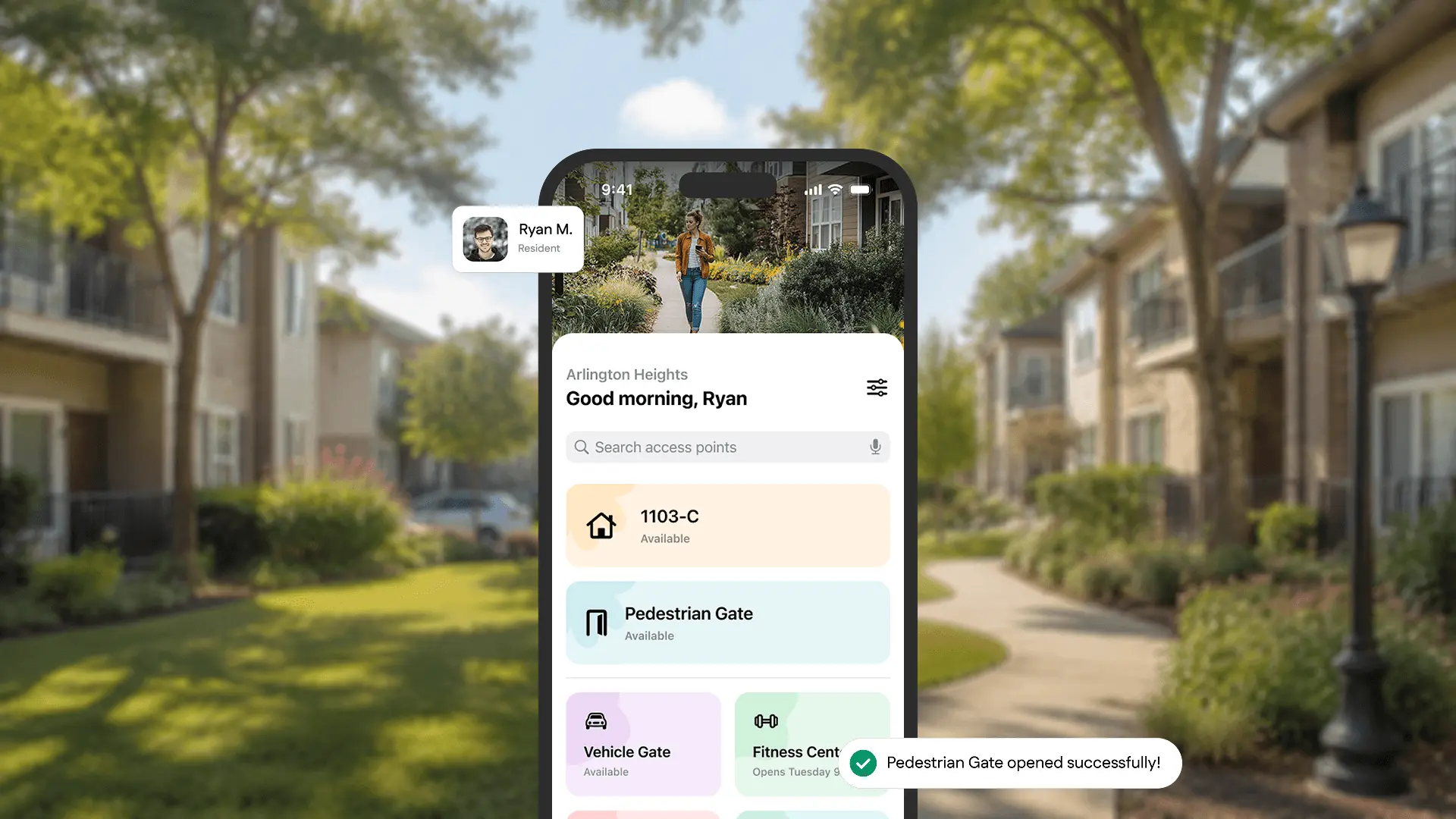
Residents expect smartphone-based entry. Mobile apps and browser-based credentials have become the baseline for how residents interact with their community. From opening gates to unlocking their front door, the smartphone is the new key. Residents, staff, and vendors can access gates and doors with the tap of a button on their phone.
Physical key management is a drag on operations. Smart locks eliminate key tracking, rekeying, and the large key rings that maintenance teams carry from building to building. According to industry security analysts, traditional rekeying can cost $75 to $250 per unit per turnover, costs that digital credential reassignment eliminates entirely.
Detailed access logs strengthen security. Property-grade smart access platforms provide timestamped records of who entered which unit and when, giving property managers and regional managers a real-time audit trail for residents, staff, vendors, and prospects.
Turnover gets faster. Digital credentials can be reassigned instantly at move-out instead of dispatching a locksmith. With deep PMS integration, access automatically activates at move-in and deactivates at move-out with no manual updates, saving both time and money during the turn cycle.
The credential mix your smart lock supports determines who can access a unit, how they access it, and how much flexibility your team has. Here are the five credential categories to evaluate.
Most multifamily-focused platforms now treat the resident's phone as the primary credential. App-based unlocking covers gates, amenities, and unit doors from a single interface. Gatewise, for example, provides a mobile-first access platform where residents use a single app to open gates, doors, and amenity spaces. For property managers, this means instant credential provisioning at move-in and instant revocation at move-out, with no physical handoff required.
Many 2025 and 2026 smart locks combine keypad, app, mechanical key, and fingerprint reader in a single device. The appeal is clear: a fingerprint door lock requires no credential at all, just the resident's finger. Reviews of top 2025 smart locks describe 6-in-1 systems including fingerprint, passcode, mobile app, NFC, mechanical key, and auto-unlock features. The biometric trend is also moving beyond simple fingerprint scanning: an industry report on next-generation biometric smart locks describes the transition toward 3D facial recognition and vein recognition between 2025 and 2026, offering higher spoof resistance for higher-security deployments.
For multifamily, biometric credentials are best suited as one layer in a multi-credential strategy rather than the sole access method, since not all residents or visitors will have enrolled fingerprints.
Time-bound PIN codes are the workhorse credential for self-guided tours and vendor access. A prospect books a tour, receives a PIN that works only during a set window, and the code expires automatically. No staff involvement, no security risk from a lingering credential. Gatewise's self-guided tour platform issues temporary digital keys after identity verification with access logs tracking every entry.
Even the most advanced smart locks commonly retain a mechanical key cylinder for emergency override. This fail-safe matters when batteries die, electronics fail, or a resident's phone is unavailable. Multiple 2025 smart lock models still include mechanical keys as standard backup alongside their digital options.
Wallet-based credentials through Apple Wallet and Google Wallet are emerging as a key resident expectation. Tap-and-go entry without opening an app removes friction from the daily experience, and wallet keys can function even when a phone's main battery is depleted. At OPTECH 2025, Allegion, Zentra, and Gatewise announced expanded wallet-based access control solutions for multifamily, setting a new standard for mobile-first access, signaling that this capability is moving from early-adopter to mainstream.
Key guidance: For property-grade deployments, look for access control products that support multiple credential types simultaneously (mobile app, wallet pass, PIN, mechanical key, and optionally biometric) so you can serve residents, staff, vendors, and low-tech users with one unified strategy.
The way your smart lock communicates with the cloud and with residents' phones has a direct impact on reliability, installation cost, and how well the system works across different property types.
Cellular-enabled access control technology is especially attractive for garden style apartments or distributed properties because it avoids dependency on property WiFi at every door. Central cellular receivers can serve multiple entry points, simplifying deployment compared to installing WiFi infrastructure per building. Gatewise uses cellular receivers that do not require internet at each door, allowing small properties to be operational in hours and large properties in one to two days. This approach is particularly powerful for improving net operating income through smart access by reducing infrastructure costs and enabling self-guided tours across an entire portfolio.
Many residential smart locks ship with built-in WiFi or optional WiFi bridges for remote control from anywhere. However, for multifamily deployments, WiFi-based unit locks require robust building connectivity and careful network design to ensure reliability across dozens or hundreds of doors. 2025 smart lock guides describe WiFi-enabled models controlled from anywhere via phone, but these are primarily designed for single-family or small rental contexts, not portfolio-scale operations.
Bluetooth is widely used for short-range, phone-to-lock communication and allows local unlocking even when cloud connectivity is temporarily unavailable. It is a useful complementary protocol but not a standalone solution for portfolio-scale management.
Z-Wave and Zigbee remain common for smart unit locks that are part of a broader smart apartment network, offering low power consumption and mesh networking. These protocols maximize both features and battery life in lock hardware.
Connectivity takeaway: For garden style or widely spread properties, prioritize cellular-centric access control solutions or hub-based radio systems that do not require property WiFi at each unit. For high-rises with existing robust connectivity, WiFi or Z-Wave locks integrated into a smart apartment platform may be the better fit.
A smart lock that operates in isolation is a consumer gadget. A smart lock that ties into your property management system is an operational asset. Integration is what separates innovative access control from a standalone deadbolt with an app.
Integration with major multifamily PMS platforms like Yardi, RealPage, Entrata, and ResMan is now a standard requirement. Gatewise, for example, offers deep connections with Yardi, RealPage, Entrata, and ResMan, enabling automated move management. This connection ensures that access is automatically tied to the lease lifecycle: credentials activate at move-in and deactivate at move-out, eliminating manual changes and reducing security risk.
Self-guided tour platforms increasingly integrate directly with access control systems so that prospects receive time-limited digital keys or PINs tied to their tour reservations. Gatewise provides a cloud-based access control infrastructure that issues temporary digital keys for self-guided tours, automating the entire leasing funnel from booking to door.
Portfolio-level centralization allows regional managers and property owners to monitor multiple properties, standardize policies, and generate reporting from a single dashboard. Gatewise's management portal supports monitoring entries across all properties in real time. If you are evaluating a best building management system or running a property management system comparison, confirm that any access control vendor supports centralized, multi-property management out of the box.
A lock that fails when the power goes out or the battery dies is not a security asset. It is a liability. Reliability is a non-negotiable for any commercial access control system.
Battery-powered unit locks typically deliver six to twelve months of battery life, aided by low-power radios like Z-Wave and Bluetooth. Low-battery alerts and long battery performance are now standard features in property-grade smart locks, delivered via the management platform or app to help teams replace batteries before a lockout occurs.
Mechanical key override remains a critical fail-safe when batteries are dead or electronics fail. Even the most advanced access control products should include this backup.
Wallet-based keys add another layer of resilience: digital keys stored in Apple or Google Wallet support access even when a device has no charge, preventing lockouts and acting as a form of uninterruptible power supply for resident access.
Cellular connectivity also plays a reliability role: cellular receivers at the gate or perimeter level continue functioning during property-wide internet outages, which is especially valuable for gate access control at sprawling communities.
Not all smart locks are created equal, and the gap between consumer-grade and property-grade access control products is significant.
Modern smart access platforms use encrypted communication and cloud-based infrastructure, though specific standards (TLS, AES) vary by vendor and are typically documented in technical spec sheets rather than marketing pages. Gatewise describes a cloud-based access control infrastructure for secure access with real-time tracking.
Anti-tampering and intrusion alerts, such as notifications of forced entry attempts or repeated failed codes, are common in both residential and best commercial access control systems. Many 2025 and 2026 smart locks also feature anti-peep password protection and tamper alarms to prevent code observation.
Detailed access logs, including timestamped entries for residents, staff, vendors, and prospects, are the primary differentiator between consumer and property-grade systems. Gatewise's management portal provides access log visibility showing every time someone opens a gate or door at your property. Remote lock/unlock and the ability to revoke credentials instantly are core capabilities of cloud-managed multifamily access control systems.
How a lock gets installed and maintained over its life has a direct impact on your total cost and your team's workload.
Retrofit smart unit locks are common in multifamily because they allow replacing existing deadbolts or latchsets with minimal door preparation. Look for access control manufacturers whose products are specifically designed for existing apartment doors and can be installed without significant modifications.
Gate and common-area hardware may be centralized (e.g., gate controllers or cellular receivers) while unit locks are installed per door, creating a hybrid deployment model that balances infrastructure investment with per-door cost. Gatewise's hardware lives in one spot while managing multiple gates and doors across the property.
Installation timelines vary widely. Gatewise reports that small properties can be operational in hours and larger sites in one to two days when using cellular receivers instead of door-by-door networked devices.
Warranty and replacement-part availability are crucial to total cost. Gatewise provides a lifetime warranty on its hardware, with free replacement if a unit stops working. This lifetime hardware warranty reduces replacement cost risk significantly for property owners evaluating long-term total cost of ownership.
Understanding what is NOI in real estate helps frame the smart lock decision. Net operating income improves when you reduce operating expenses (like rekeying and locksmith calls) and increase revenue (through faster leasing and higher occupancy). Smart unit locks affect both sides of the net operating income formula.
Upfront hardware cost: Multifamily-oriented smart locks typically fall in the $150 to $300 per unit range, compared to roughly $30 to $50 for conventional hardware. Installation for smart locks can add $250 to $400 per door when using professional installers, though this varies by region and complexity.
Rekeying savings: Traditional lock rekeying often costs $75 to $250 per unit per turnover. For a property with 50 doors, switching to smart locks could save over $3,000 annually in rekeying costs alone. Security analysts estimate a total potential annual ROI of $15,000 to $40,000 or more for a 150-unit property when factoring in rekeying, lockouts, turnover labor, and staffing efficiency.
Long-term ROI: Keyless entry systems provide ongoing returns through reduced rekeying, fewer lockouts (via remote unlocks), and time savings for staff. Gatewise offers an ROI calculator that helps property managers and owners estimate their specific savings based on portfolio size, turnover rate, and current access control costs.
Monthly subscription fees: Cloud management, PMS integration, and self-guided tour functionality typically come with monthly per-unit or per-access-point fees that vary by vendor. Gatewise structures its contracts with simple monthly pricing and 30-day terms, reducing vendor lock-in and aligning costs with portfolio size. Factor these into your NOI meaning real estate calculations alongside the rekeying and lockout savings to get an accurate total cost picture.
The right smart lock and access control strategy varies significantly based on your property type. Here is what to prioritize for each.
Spread-out campuses and multiple buildings favor cellular or hub-based systems that do not rely on building WiFi at every door. Centralized management portals that let staff oversee many buildings and access points from one interface are essential in garden style apartments layouts. Budget constraints at Class B and C properties also favor transparent, predictable pricing without long-term hardware contracts. Gatewise's cellular receivers are specifically designed for sprawling communities and do not need internet at each door, and the platform's NOI-focused approach helps Class B and C properties improve operations and enable self-guided tours.
High-rise buildings need integration between unit locks, elevator control, and perimeter access so residents and visitors can be granted floor-specific rights. Stronger security expectations, including visitor management and video intercom system functionality, mean unit locks should sit within a broader access ecosystem rather than as standalone devices. The Allegion ecosystem provides a unified strategy from curb to couch.
High turnover rates and numerous roommates make digital credential management particularly valuable. Smart locks enable quick reassignments and time-limited access for each academic cycle. Gatewise's student housing solution is built for the academic calendar, with mobile-first access that handles seasonal demand surges. Self-guided tours and automated gate access for prospects and maintenance staff help leasing teams keep up during peak leasing periods.
Mixed-use buildings often require different schedules and permissions for residential versus commercial tenants. This calls for role-based access control in the platform, with the ability to assign custom permissions by user type. Gatewise's management portal allows setting custom permissions by role, including leasing agents, maintenance technicians, and contractors, each with different access windows and entry points.
Simpler interfaces, voice activation, and dependable access for caregivers and emergency responders are important design considerations. Gatewise supports voice activation via Siri and Google Assistant for hands-free gate and door opening, one of residents' most-loved features. Wallet-based keys that work even when a device battery is low or dead help avoid lockouts for vulnerable populations.
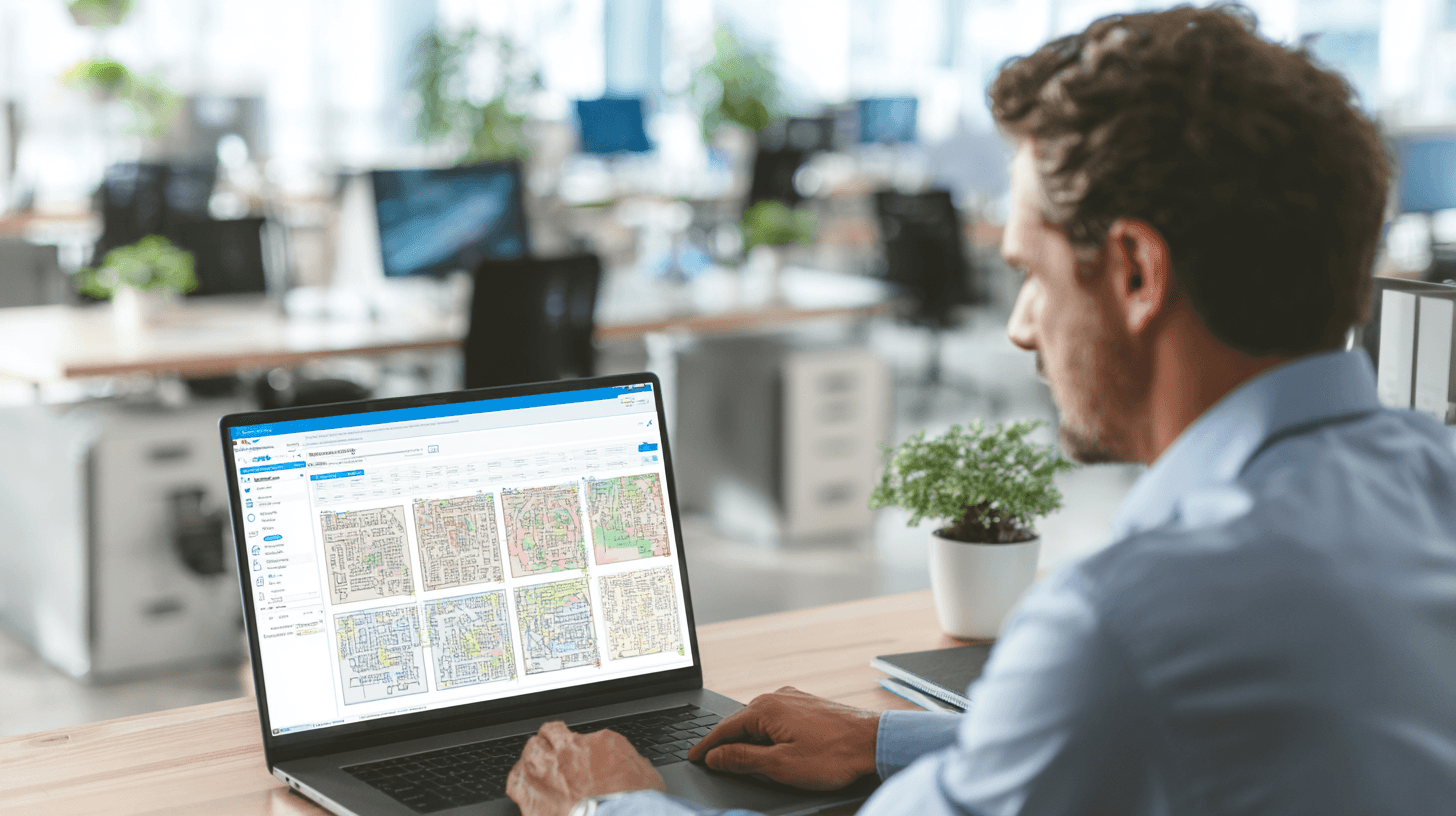
Deploying consumer-grade locks in a commercial setting. Single-family-focused WiFi deadbolts lack the scalability, PMS integration, and fleet management features that multifamily demands. The NAA reports that nearly half of multifamily professionals now use smart locks in some capacity, but the key is choosing products built specifically for the rental industry rather than repurposing consumer hardware.
Ignoring PMS and CRM integration. Without automated move-in provisioning and move-out deactivation tied to your lease lifecycle, you are back to manual credential changes, which increases security risk and staff workload. Deep PMS integration with Yardi, RealPage, Entrata, and ResMan should be a baseline requirement for any vendor you evaluate.
Over-relying on WiFi at every door. WiFi coverage gaps in older buildings or spread-out sites can cripple a WiFi-only lock deployment. Cellular-centric solutions that do not require internet at each door avoid this pitfall entirely.
Overlooking total cost of ownership. Comparing the sticker price of a smart lock to a traditional deadbolt without factoring in rekeying, lockout, and staff-time savings makes traditional locks look cheaper than they actually are over a five-year horizon. Security analysts find that smart access systems can generate $15,000 to $40,000 or more in annual savings for a 150-unit property.
Selecting systems without portfolio scalability. A lock that only handles a single property in isolation will limit future flexibility as your portfolio grows. Choose access control systems with portfolio-wide dashboards, role-based permissions, and standardized policies. Gatewise offers portfolio-wide visibility for regional managers and property owners from a single dashboard.
Forgetting self-guided tour functionality. If your leasing strategy includes virtual apartment tours or self-guided showings, your unit locks must support temporary, time-bound digital credentials. Retrofitting this capability later is far more expensive than building it into your initial selection. Gatewise's self-guided tour platform issues temporary digital keys with real-time access tracking.
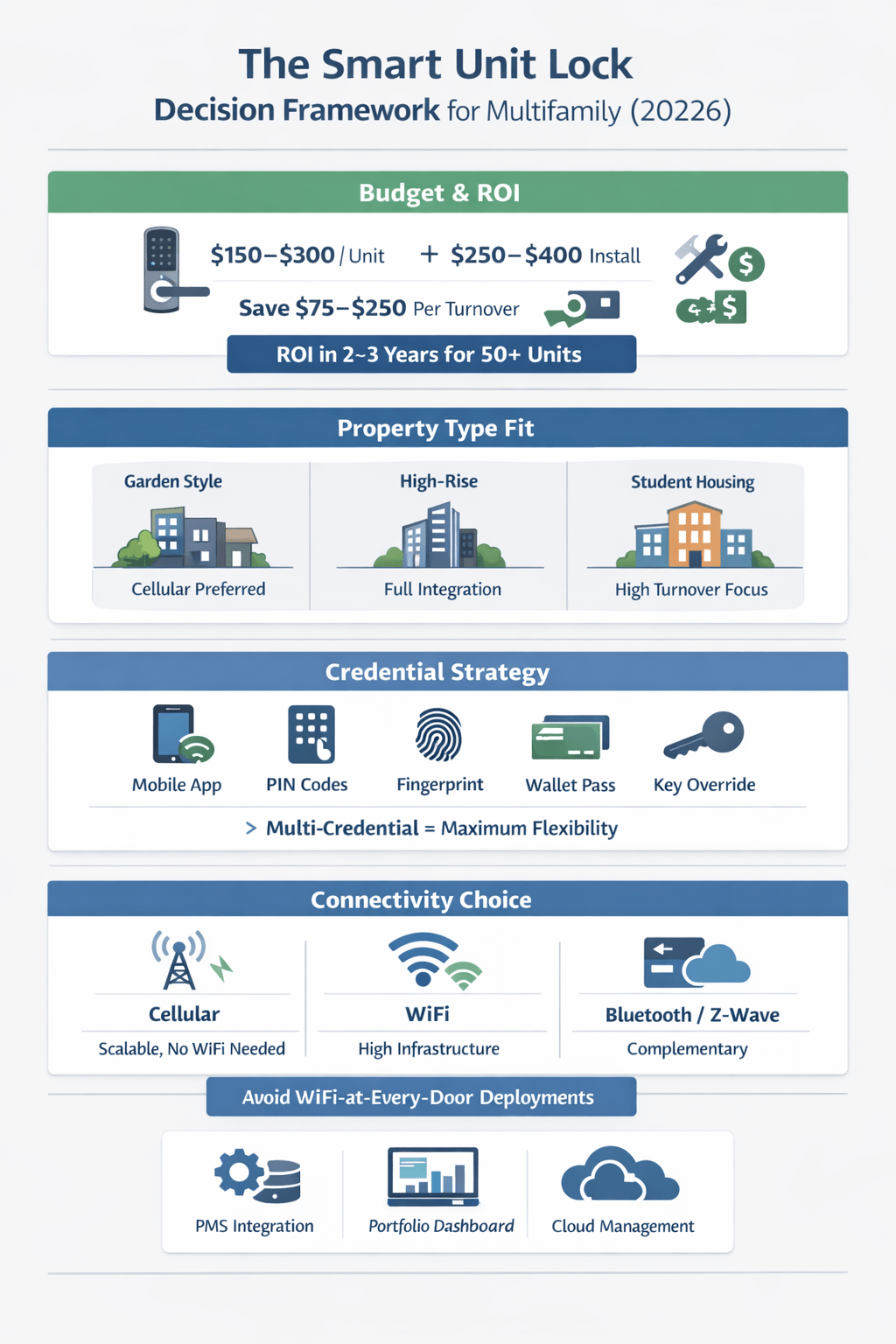
Use these five steps to evaluate access control manufacturers and select the right smart unit lock for your portfolio.
1. Budget and TCO. Compare upfront hardware and installation cost (typically $150 to $300 per lock plus $250 to $400 for installation) against the rekeying, lockout, and staff-time savings you expect. A property with 50 or more units will likely see positive ROI within two to three years. Use Gatewise's ROI calculator to model your specific scenario.
2. Property type and layout. For garden style apartments and distributed portfolios, prioritize cellular-based systems that avoid per-door WiFi. For high-rise buildings, ensure the system integrates from curb to couch, including elevators and common areas through a unified Allegion ecosystem with Zentra and Gatewise.
3. Integration requirements. Confirm support for your PMS (Yardi, RealPage, Entrata, ResMan) and any self-guided tour or CRM platforms your leasing team uses. If you are running a best property management software evaluation simultaneously, shortlist access control vendors that integrate with your top PMS candidates.
4. Scalability and portfolio strategy. Choose systems that offer portfolio-wide dashboards, role-based permissions, and standardized policies so you can manage many properties consistently as you grow.
5. Resident and prospect experience. Assess the credential mix (app, wallet, PIN, biometric, key override) and ensure it aligns with your residents' comfort level. A student housing community needs rapid credential turnover; a senior community needs voice activation and wallet-based reliability. Confirm that self-guided tours, guest access, and vendor access workflows are fully supported and automated. The biometric smart lock trend toward facial and vein recognition may also influence your decision for premium or high-security properties.
Smart unit locks are no longer a nice-to-have tech upgrade. In 2026, they are a strategic lever for net operating income, resident retention, leasing velocity, and portfolio-wide security. By evaluating credential types, connectivity, PMS integration, total cost of ownership, and property-type fit using the framework above, you can choose a system that makes your communities safer, your operations leaner, and your bottom line stronger.
Learn more about Unit lock solutions by Gatewise to get started.
Gatewise offers a simple and modern gate entry system that provides residents with a mobile app and managers with a cloud-based management portal.